Microbial Alkaline Proteases From A Bioindustrial Viewpoint
Compare microbial alkaline protease specs for laundry detergent: pH, temperature, activity, stability, QC, pilot validation, and supplier qualification.
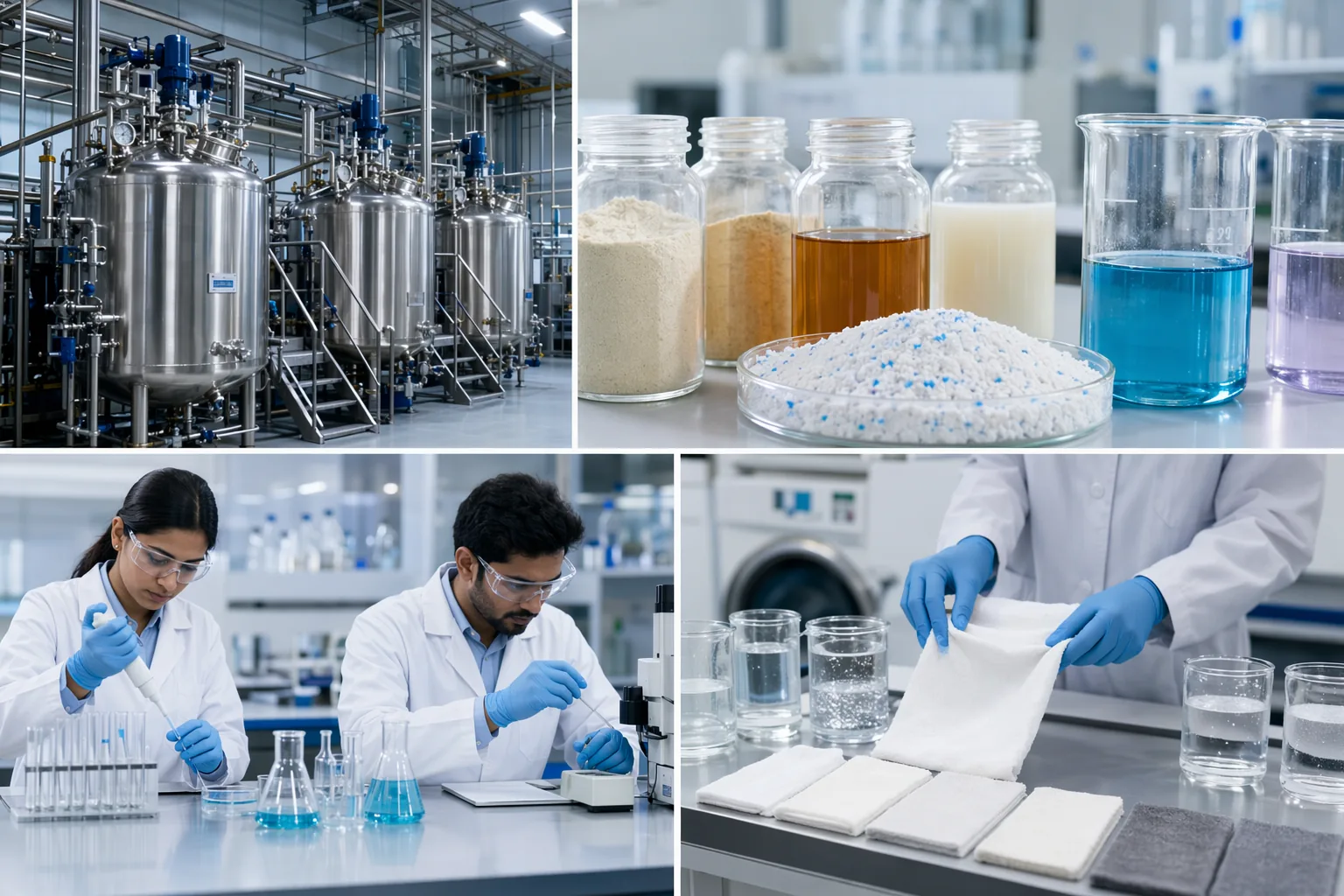
A practical specification checklist for detergent manufacturers comparing alkaline protease enzyme options for stain removal, formulation stability, and cost-in-use.
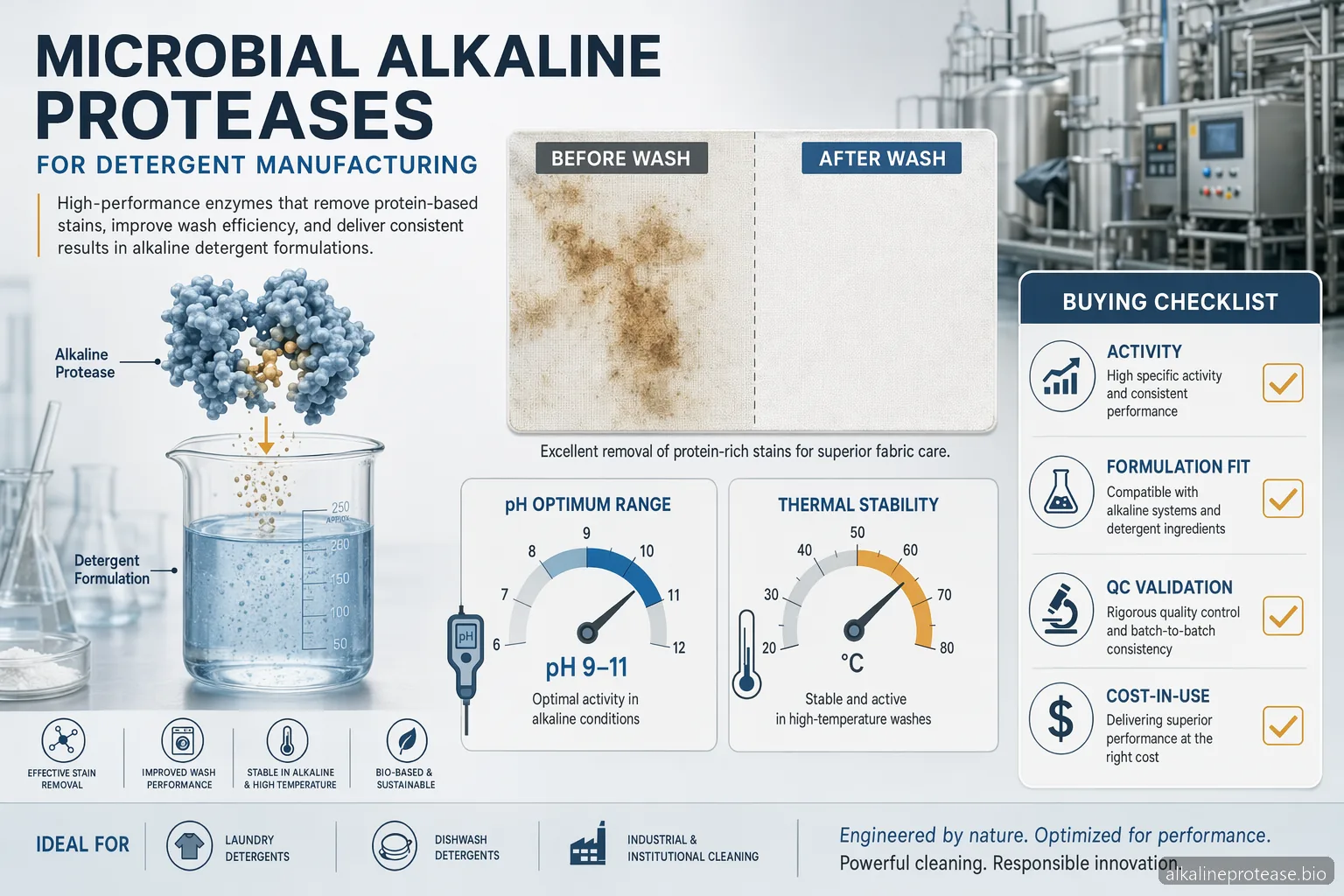
Why microbial alkaline proteases matter in detergent buying
Microbial alkaline proteases are among the most widely specified enzyme classes for laundry detergent because they hydrolyze protein-based soils such as blood, egg, milk, grass, sweat, and food residues under alkaline wash conditions. From a bioindustrial viewpoint, the buyer’s question is not whether alkaline protease works, but which alkaline protease enzyme gives the best balance of stain removal, stability, processing fit, and cost-in-use. For powder, liquid, unit-dose, and institutional laundry formats, procurement and R&D teams should compare enzyme form, activity method, pH profile, thermal tolerance, compatibility with surfactants, and shelf stability. The microbial alkaline proteases importance is strongest where lower wash temperatures, shorter cycles, and phosphate-reduced formulations are required. A detergent-grade subtilisin or related alkaline protease should be assessed against the actual formulation matrix, not only against generic laboratory activity claims.
Best fit: proteinaceous stain removal in alkaline laundry systems • Typical operating pH: about 8.5–11.0 depending on formulation • Common wash temperature window: 25–60°C • Key business metric: cost per effective wash, not price per kilogram
Specification comparison: activity, pH, and temperature
When comparing alkaline protease detergent options, start with the analytical method used to declare activity. Casein, azocasein, or other substrate-based assays can produce different numerical units, so units from two suppliers may not be directly interchangeable. Ask for the TDS to define assay pH, assay temperature, substrate, unit definition, and acceptance range on the COA. For laundry detergent, the useful profile normally includes strong activity from pH 9 to 10.5 and practical stain-removal contribution across 30–50°C, with some formulations requiring tolerance up to about 60°C. A high headline activity is less valuable if the enzyme loses performance in the presence of anionic surfactants, nonionic surfactants, builders, oxidants, chelants, or fragrance systems. For liquid detergents, protease autolysis and interaction with other enzymes can also affect finished-product stability.
Compare declared units only when assay methods match • Request retained activity data after storage in the target base • Check both short-cycle and long-cycle wash performance • Confirm whether granule, liquid, or coated form is appropriate
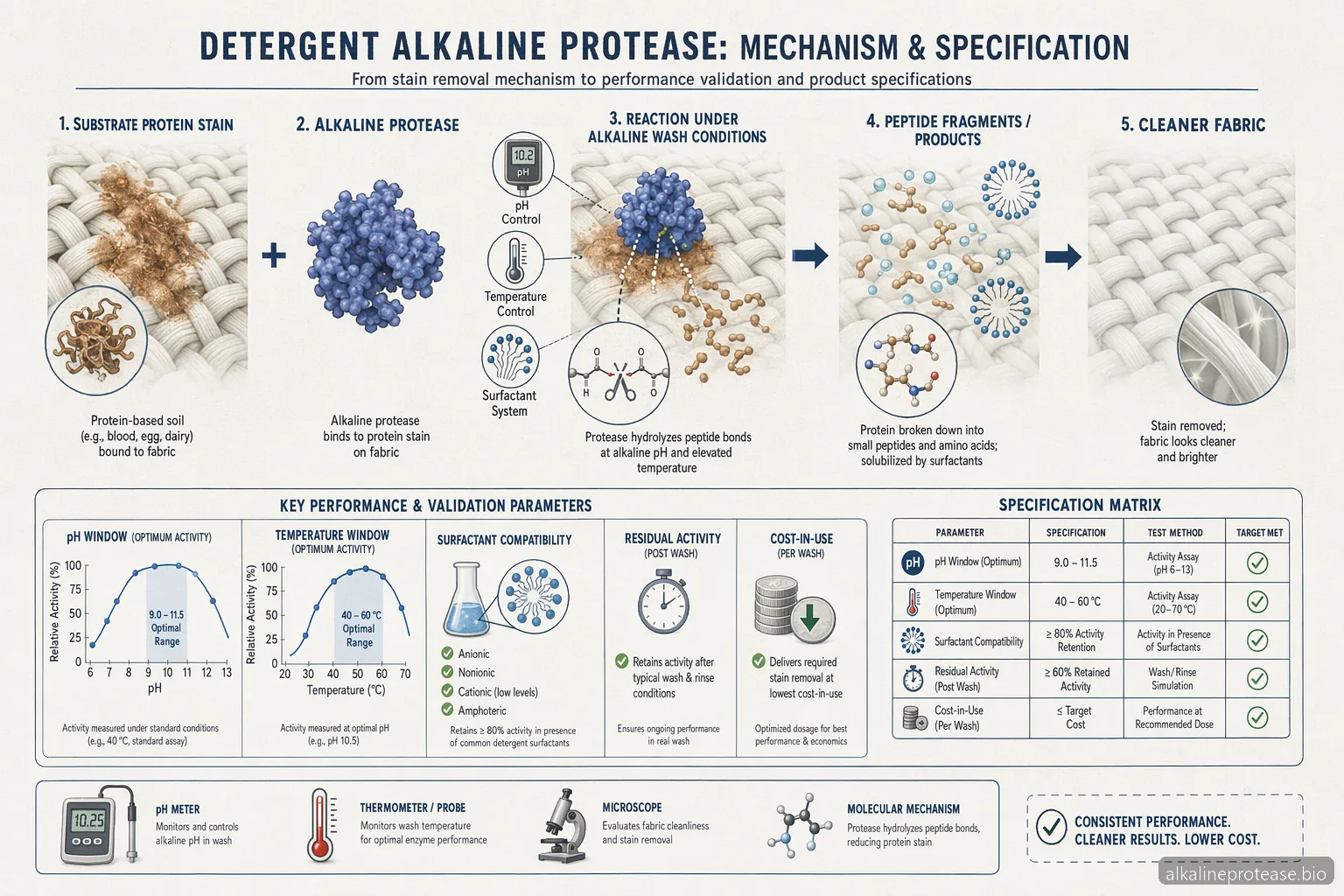
Formulation fit for laundry detergent manufacturing
Alkaline protease performance must survive the full detergent manufacturing route, not just the consumer wash. In powders, granulated protease should be evaluated for dust control, coating integrity, segregation risk, and activity retention after post-addition blending. Excessive shear, high local moisture, or prolonged exposure to alkaline salts can reduce recoverable activity. In liquids, the alkaline protease enzyme must be screened for compatibility with water activity, pH, hydrotropes, solvents, preservatives, builders, and other enzymes. Many liquid detergent systems require stabilizers such as calcium salts, borates where permitted, polyols, or other formulation-specific stabilizing systems; the choice depends on regulatory and customer constraints. Typical enzyme dosage is often explored in the range of 0.1–1.0% product as supplied, but the correct band depends on activity, wash dose, soil load, and target claim level.
Powders: evaluate granule integrity, dust, and blend uniformity • Liquids: test enzyme stability in the finished base • Pilot dosage screen: commonly 0.1–1.0% as supplied • QC focus: activity recovery after processing and storage
Microbial sources versus non-industrial protease references
Industrial detergent proteases are typically produced by controlled microbial fermentation, commonly using selected Bacillus or other production organisms, followed by recovery, concentration, stabilization, and formulation. Search results may include academic topics such as alkaline proteases from the digestive tract of four tropical fishes or alkaline proteases from digestive tract of four tropical fishes. These studies can be scientifically interesting for enzyme biodiversity, but they are not the same as a scalable detergent supply chain. Buyers may also encounter phrases such as production of alkaline protease from the miccroorgansims, production of alkaline protease from pseudomonas aeruginosa, or optimization of extracellular alkaline protease enzyme from bacillus sp kanchana. For procurement, the practical comparison should emphasize strain control, fermentation reproducibility, downstream purification level, contaminant limits, allergen and dust handling, lot-to-lot activity variation, and documentation. A suitable supplier should explain source, manufacturing controls, and batch release criteria without relying on vague origin claims.
Industrial fermentation offers better scalability than exploratory sources • Do not substitute academic activity data for detergent trials • Ask how the supplier controls lot consistency • Confirm documentation before plant-scale qualification
Pilot validation, QC, and cost-in-use calculation
Before selecting from the alkaline proteases market, run a structured pilot validation. Use representative detergent base, target water hardness, realistic wash temperature, standard protein soils, customer fabrics, and actual wash dosage. Measure stain removal versus a no-enzyme control and against the incumbent enzyme where applicable. Include storage stability at intended warehouse conditions, such as 25°C long-term and accelerated studies at 35–40°C where suitable for the product format. QC checks should include enzyme activity, appearance, odor, moisture for granules, pH where relevant, microbial limits when specified, and retained activity in finished detergent. Cost-in-use should include dosage needed for equal performance, activity loss during storage, rework risk, logistics, minimum order quantity, technical support, and documentation burden. Supplier qualification should include COA, TDS, SDS, change-control expectations, traceability, manufacturing site information, and responsiveness during troubleshooting.
Benchmark against no-enzyme and incumbent controls • Use realistic soils, fabrics, hardness, and wash conditions • Calculate cost per effective wash after stability loss • Qualify both product performance and supplier reliability
Technical Buying Checklist
Buyer Questions
Do not compare activity numbers unless the assay method is the same. Ask each supplier for the substrate, pH, temperature, incubation time, unit definition, and acceptance range used on the COA. Then run equal-cost and equal-activity wash trials in your own detergent base. Performance on protein soils under real wash conditions is more useful than a headline activity value alone.
Many detergent applications screen alkaline protease around pH 8.5–11.0 and wash temperatures from 25–60°C. The most important range depends on the final product, such as cold-wash liquid, powder detergent, or institutional laundry system. Buyers should test activity, stability, and stain removal at the finished detergent pH, target wash temperature, water hardness, and expected storage conditions.
Request a current COA for the lot, TDS with activity method and use guidance, SDS for safe handling, and available stability data. For supplier qualification, also ask about traceability, manufacturing site controls, batch release criteria, change notification practices, packaging, shelf life, and technical support. These documents help procurement, R&D, EHS, and quality teams evaluate both product suitability and supply reliability.
Cost-in-use should include the enzyme dose required to achieve target stain removal, not only the purchase price per kilogram. Include activity loss during processing and storage, wash dose, logistics, minimum order quantity, handling requirements, and failure risk. A more expensive enzyme may be lower cost-in-use if it allows lower dosage, better shelf stability, or more consistent protein stain removal.
Alkaline Protease for Research & Industry
Need Alkaline Protease for your lab or production process?
ISO 9001 certified · Food-grade & research-grade · Ships to 80+ countries
Frequently Asked Questions
How should detergent buyers compare alkaline protease activity units?
Do not compare activity numbers unless the assay method is the same. Ask each supplier for the substrate, pH, temperature, incubation time, unit definition, and acceptance range used on the COA. Then run equal-cost and equal-activity wash trials in your own detergent base. Performance on protein soils under real wash conditions is more useful than a headline activity value alone.
What pH and temperature range is typical for laundry alkaline protease?
Many detergent applications screen alkaline protease around pH 8.5–11.0 and wash temperatures from 25–60°C. The most important range depends on the final product, such as cold-wash liquid, powder detergent, or institutional laundry system. Buyers should test activity, stability, and stain removal at the finished detergent pH, target wash temperature, water hardness, and expected storage conditions.
What documents should be requested from an alkaline protease supplier?
Request a current COA for the lot, TDS with activity method and use guidance, SDS for safe handling, and available stability data. For supplier qualification, also ask about traceability, manufacturing site controls, batch release criteria, change notification practices, packaging, shelf life, and technical support. These documents help procurement, R&D, EHS, and quality teams evaluate both product suitability and supply reliability.
How is cost-in-use calculated for alkaline protease detergent formulations?
Cost-in-use should include the enzyme dose required to achieve target stain removal, not only the purchase price per kilogram. Include activity loss during processing and storage, wash dose, logistics, minimum order quantity, handling requirements, and failure risk. A more expensive enzyme may be lower cost-in-use if it allows lower dosage, better shelf stability, or more consistent protein stain removal.
Related: Alkaline Protease for Detergent and Laundry Formulation
Turn This Guide Into a Supplier Brief Request a detergent-grade alkaline protease specification review, sample, and pilot validation plan. See our application page for Alkaline Protease for Detergent and Laundry Formulation at /applications/alkaline-protease-detergent-laundry/ for specs, MOQ, and a free 50 g sample.
Contact Us to Contributehello@mail.alkalineprotease.bio