Alkaline Protease Function in Detergents: Dosage, pH, and Temperature Control
Troubleshoot detergent enzymes like alkaline protease: dosage, pH, temperature, QC, pilot validation, COA/TDS/SDS, and supplier qualification.
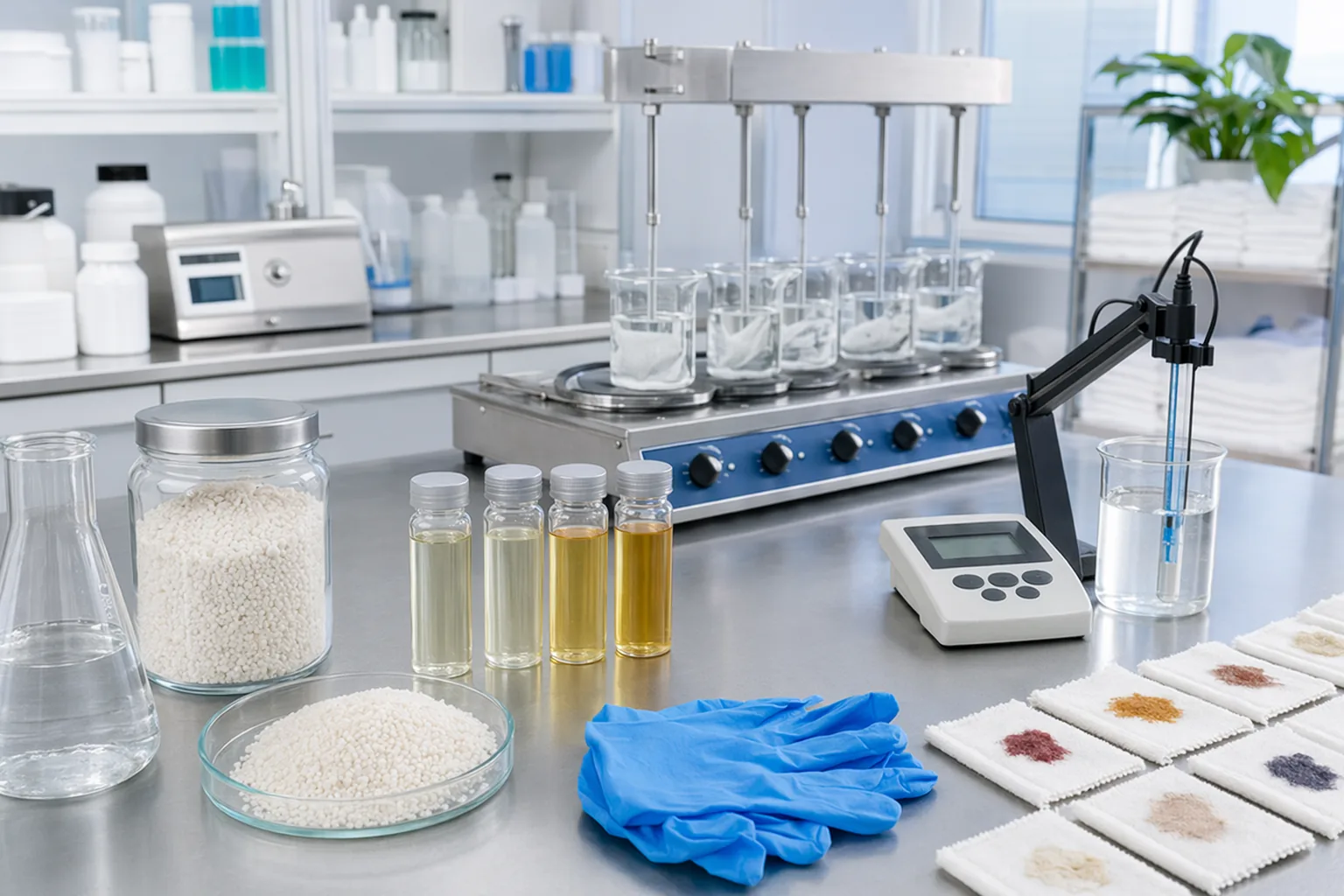
A practical guide for detergent formulators and procurement teams troubleshooting wash performance, enzyme stability, and cost-in-use with alkaline protease.
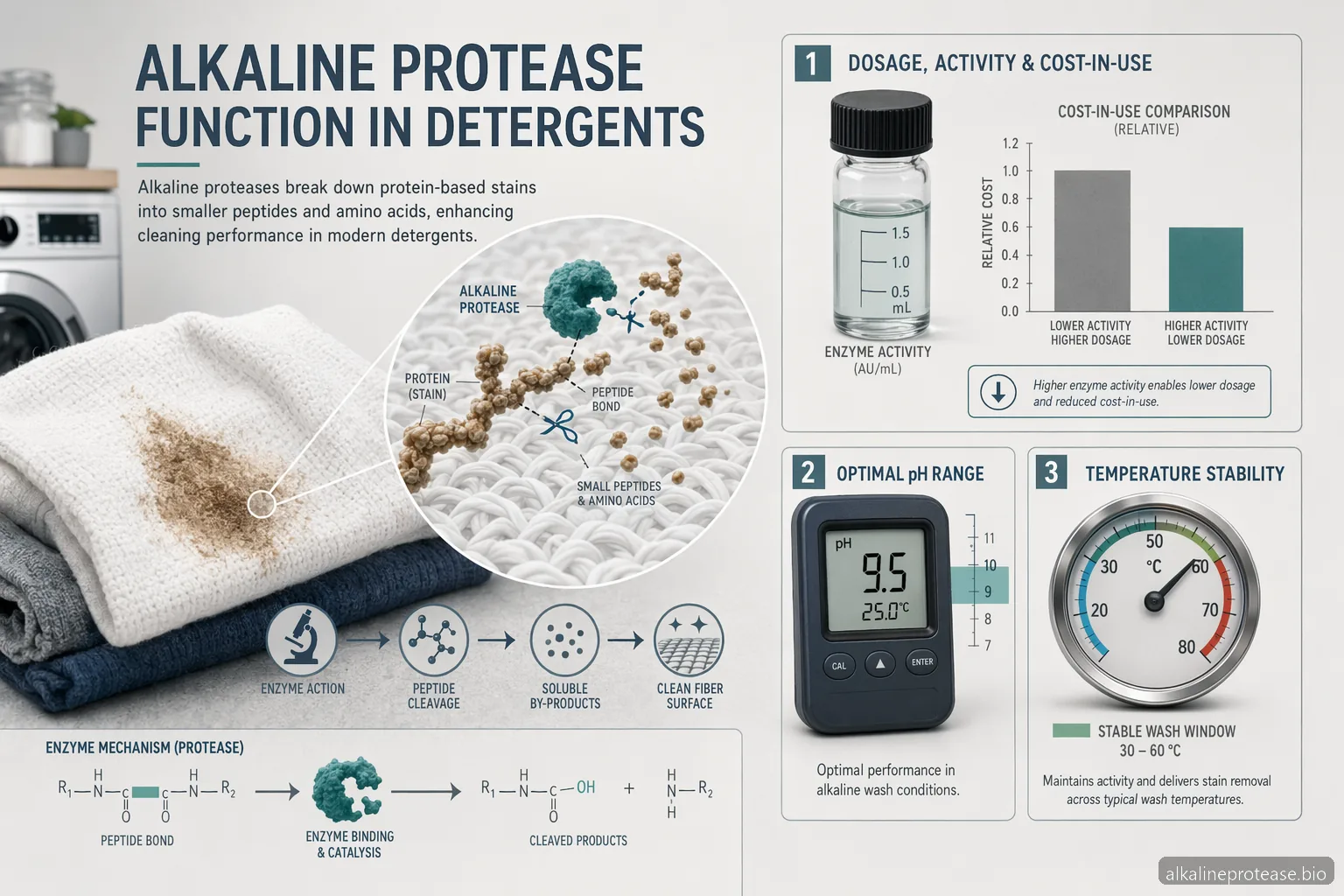
What Is Alkaline Protease in Laundry Detergent?
Alkaline protease is a protein-degrading industrial enzyme used to improve stain removal in powder, liquid, and unit-dose laundry detergents. The function of alkaline protease is to cleave peptide bonds in protein soils, converting insoluble stains into smaller fragments that surfactants, builders, and mechanical wash action can remove more easily. Many commercial alkaline protease products are subtilisin-type serine proteases produced by alkaline protease producing bacteria such as selected Bacillus strains. For detergent buyers, the key question is not only what is alkaline protease, but whether the supplied enzyme remains active in the intended formulation, storage, and wash environment. The alkaline protease enzyme in detergents must tolerate alkaline pH, surfactants, builders, and practical consumer wash temperatures while maintaining acceptable shelf stability and low dust exposure during manufacturing. As one of the core detergent enzymes in modern laundry formulations, alkaline protease typically works alongside amylase and lipase to cover a broader range of stain types.
Main target soils: blood, egg, milk, grass, sweat, and food proteins • Common formats: coated granules for powders and stabilized liquids for liquid detergents • Typical detergent wash pH: about 8.5-11.0 depending on market and product format
Dosage: Start With Activity, Then Confirm Cost-in-Use
Alkaline protease dosage should be based on declared activity units, detergent format, target stain claims, and the local wash profile. A common screening range for detergent formulation is roughly 0.2-1.5% enzyme granule in powder detergents or 0.05-0.5% liquid enzyme preparation in liquid detergents, but the correct level depends on the supplier's activity, stabilization system, and soil panel results. Do not compare products by weight alone; compare delivered active enzyme units per kilogram of finished detergent and the cost per effective wash. During troubleshooting, test at least three dosage points around the supplier's recommended use level and include a no-enzyme control. If increasing dosage no longer improves stain removal, the limitation may be pH, wash temperature, surfactant system, enzyme deactivation, or insufficient contact time rather than enzyme concentration.
Request activity method and unit definition on the COA or TDS • Run side-by-side wash tests with equal activity, not equal mass • Calculate cost-in-use per ton of detergent and per consumer wash
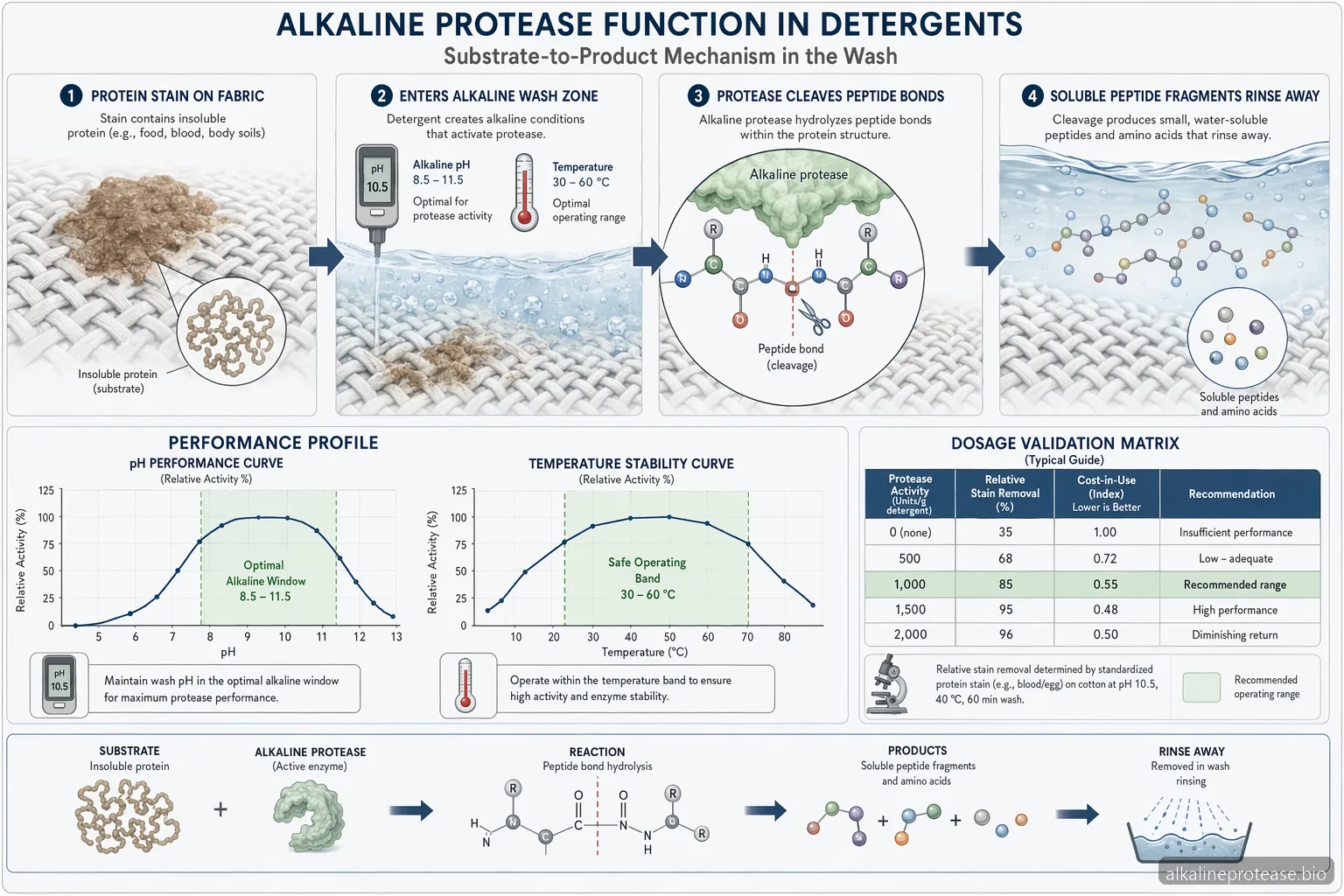
pH and Temperature Windows for Stable Performance
The alkaline protease function in detergents depends strongly on pH and temperature. Many subtilisin-based alkaline proteases perform best in alkaline systems, commonly around pH 9.0-10.5, with useful activity often extending from about pH 8.0-11.0 depending on the strain and enzyme engineering. Temperature response also matters: modern laundry may use cold, warm, or hot cycles, so evaluate performance at 20°C, 30°C, 40°C, and 60°C if those conditions are commercially relevant. Higher temperature can accelerate stain hydrolysis but may also increase enzyme denaturation in aggressive formulations. For liquid detergents, stability at storage temperature is often more important than peak activity in a laboratory buffer. The alkaline protease solution function should therefore be assessed both in-wash and after accelerated storage in the finished formulation.
Screen wash pH before and after detergent dissolution • Check activity retention after storage at ambient and elevated temperature • Avoid assuming buffer activity equals finished-detergent performance
Troubleshooting Weak Stain Removal
When the alkaline protease enzyme in detergents underperforms, isolate the root cause before changing suppliers. Confirm that the enzyme was stored dry, cool, and sealed, and verify activity against a retained sample or incoming COA value. In powder detergent, excess moisture, poor coating integrity, high alkalinity, or oxidizing components can reduce stability. In liquid detergent, protease may be affected by water activity, solvents, chelants, preservatives, and interaction with other enzymes. Bleach systems require special attention because oxidants can inactivate proteases unless the enzyme format and formulation are designed for compatibility. Also check whether the stain panel is protein-rich enough to show the alkaline protease function. A weak result on oily stains alone may not indicate protease failure, because lipase, surfactants, builders, or emulsification may be the primary drivers.
Compare fresh enzyme, stored enzyme, and finished detergent activity • Check moisture, pH, oxidants, and storage temperature • Use protein-specific stain swatches in the test matrix • Confirm detergent dissolution and wash contact time
Supplier Qualification and Pilot Validation
Industrial buyers should qualify alkaline protease suppliers with documentation, application testing, and supply risk review. Request a current COA for each lot, a TDS with activity, recommended dosage, pH and temperature guidance, and an SDS covering safe handling, dust control, and exposure precautions. Ask whether the supplier can support detergent-specific pilot validation rather than only generic enzyme data. A practical pilot should include incoming QC, formulation compatibility, accelerated stability, wash performance, packaging trials, and retained samples for investigation. For the alkaline protease solution function in purification or other non-detergent processes, request separate data because detergent conditions are not automatically transferable. Supplier selection should balance activity, stability, technical support, lead time, batch consistency, regulatory documentation for the target market, and total cost-in-use.
Review COA, TDS, SDS, allergen handling guidance, and lot traceability • Run pilot batches before commercial conversion • Audit consistency using retained samples and repeat activity tests • Base approval on performance and cost-in-use, not price per kilogram alone
Technical Buying Checklist
Buyer Questions
The alkaline protease function in detergents is to break down protein-based stains under alkaline washing conditions. It hydrolyzes peptide bonds in soils such as blood, egg, milk, sweat, grass, and food residues. The resulting smaller fragments are easier for surfactants, builders, and mechanical agitation to remove from fabric. It is not a general-purpose stain remover for every soil type.
A practical starting screen is about 0.2-1.5% enzyme granule in powder detergent or 0.05-0.5% liquid enzyme preparation in liquid detergent, depending on supplier activity and formulation type. Final dosage should be based on activity units, stain panel performance, stability after storage, and cost-in-use. Always compare enzyme products at equivalent declared activity rather than equal weight.
Activity loss may be caused by excessive moisture, high storage temperature, oxidizing bleach, incompatible surfactants, extreme pH, unsuitable solvents, or poor enzyme granule protection. In liquid detergent, water activity and preservative systems can also matter. Troubleshooting should compare incoming enzyme activity, finished-product activity, and retained samples after storage to separate supplier, formulation, and process causes.
Subtilisin is a major class of alkaline protease widely used in laundry detergents, but not every alkaline protease product is identical. Different subtilisin variants and production strains can differ in pH profile, temperature response, oxidation tolerance, surfactant compatibility, and stability. Buyers should review the TDS and validate performance in their own detergent formulation rather than assuming equivalent function.
Request a COA for the specific lot, a TDS with activity units and application guidance, and an SDS for safe handling. For supplier qualification, also ask for shelf-life guidance, storage conditions, activity test method, lot traceability, packaging information, and support for pilot validation. Commercial approval should include wash performance, stability, manufacturing fit, and cost-in-use analysis.
Alkaline Protease for Research & Industry
Need Alkaline Protease for your lab or production process?
ISO 9001 certified · Food-grade & research-grade · Ships to 80+ countries
Frequently Asked Questions
What is the alkaline protease function in detergents?
The alkaline protease function in detergents is to break down protein-based stains under alkaline washing conditions. It hydrolyzes peptide bonds in soils such as blood, egg, milk, sweat, grass, and food residues. The resulting smaller fragments are easier for surfactants, builders, and mechanical agitation to remove from fabric. It is not a general-purpose stain remover for every soil type.
What dosage of alkaline protease should a detergent manufacturer use?
A practical starting screen is about 0.2-1.5% enzyme granule in powder detergent or 0.05-0.5% liquid enzyme preparation in liquid detergent, depending on supplier activity and formulation type. Final dosage should be based on activity units, stain panel performance, stability after storage, and cost-in-use. Always compare enzyme products at equivalent declared activity rather than equal weight.
Why does alkaline protease lose activity in detergent?
Activity loss may be caused by excessive moisture, high storage temperature, oxidizing bleach, incompatible surfactants, extreme pH, unsuitable solvents, or poor enzyme granule protection. In liquid detergent, water activity and preservative systems can also matter. Troubleshooting should compare incoming enzyme activity, finished-product activity, and retained samples after storage to separate supplier, formulation, and process causes.
Is subtilisin the same as alkaline protease?
Subtilisin is a major class of alkaline protease widely used in laundry detergents, but not every alkaline protease product is identical. Different subtilisin variants and production strains can differ in pH profile, temperature response, oxidation tolerance, surfactant compatibility, and stability. Buyers should review the TDS and validate performance in their own detergent formulation rather than assuming equivalent function.
What documents should B2B buyers request before ordering?
Request a COA for the specific lot, a TDS with activity units and application guidance, and an SDS for safe handling. For supplier qualification, also ask for shelf-life guidance, storage conditions, activity test method, lot traceability, packaging information, and support for pilot validation. Commercial approval should include wash performance, stability, manufacturing fit, and cost-in-use analysis.
Related: Alkaline Protease for Detergent and Laundry Formulation
Turn This Guide Into a Supplier Brief Request alkaline protease samples, COA/TDS/SDS, and pilot support for your laundry detergent formulation. See our application page for Alkaline Protease for Detergent and Laundry Formulation at /applications/alkaline-protease-detergent-laundry/ for specs, MOQ, and a free 50 g sample.
Contact Us to Contributehello@mail.alkalineprotease.bio