Application of Alkaline Protease: Laundry Detergent Formulation Guide
Formulation guide for alkaline protease in laundry detergent: pH, temperature, dosage, stability checks, COA/TDS/SDS, and supplier qualification.
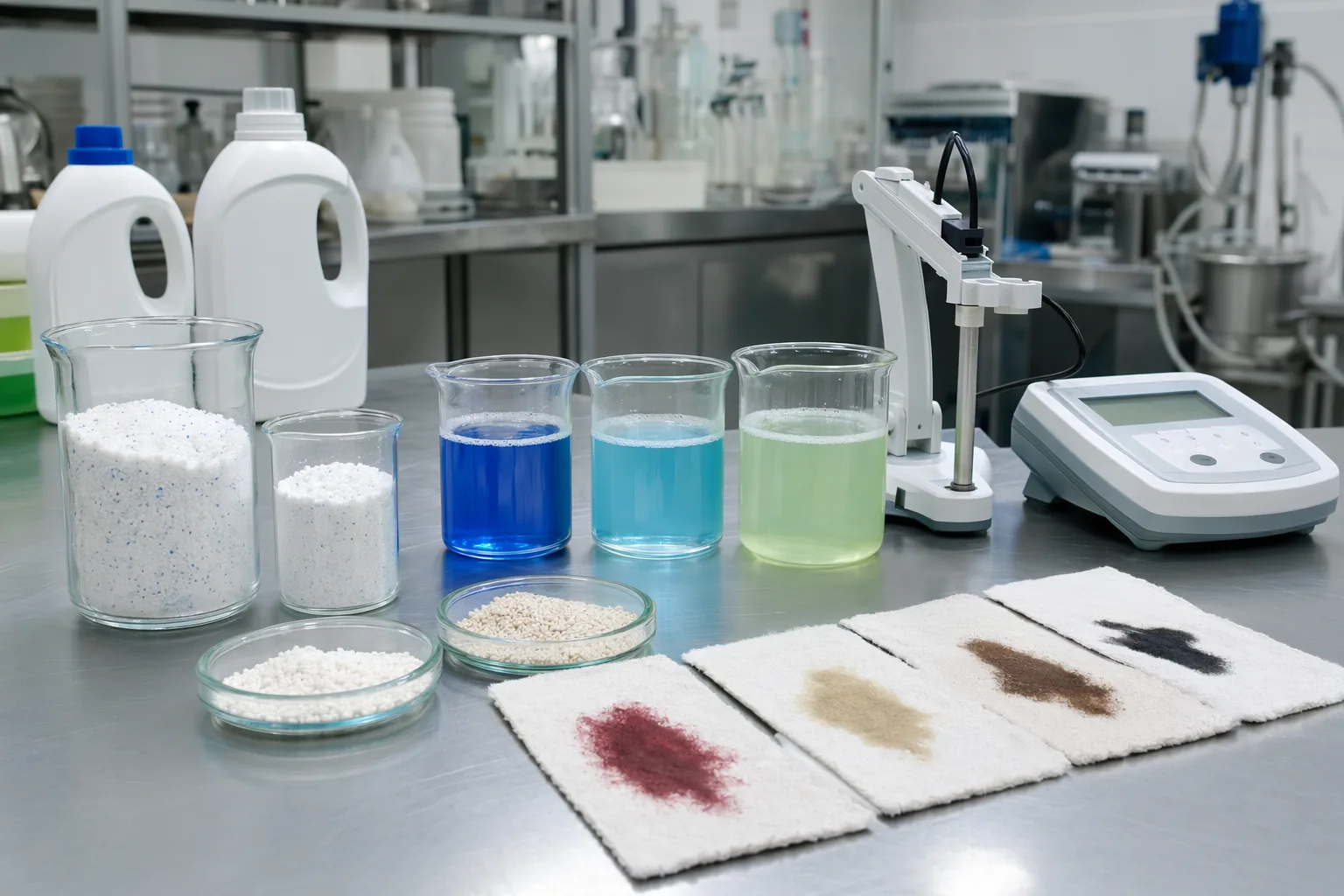
A practical B2B guide for using alkaline protease enzyme in powder and liquid laundry detergents, with formulation ranges, validation checks, and sourcing criteria.
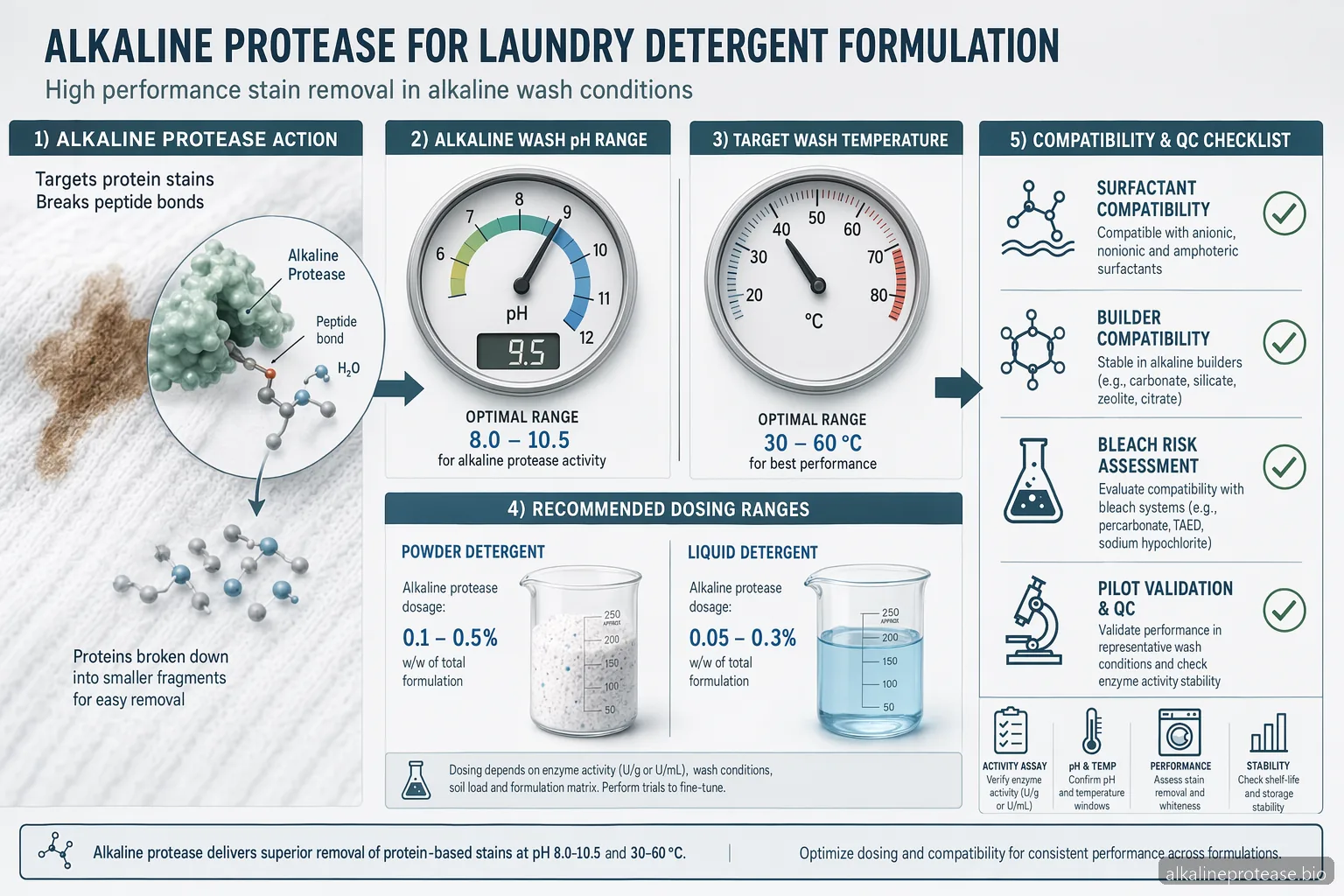
What Is Alkaline Protease in Detergent Formulation?
Alkaline protease is a protein-degrading enzyme designed to work in mildly to strongly alkaline environments. In laundry detergent, the application of alkaline protease is focused on breaking peptide bonds in protein soils so they can be lifted by surfactants and removed during rinsing. Many commercial detergent proteases are bacterial alkaline protease, often related to subtilisin-type alkaline serine protease produced by selected alkaline protease producing bacteria. For formulators, the enzyme is not evaluated as a generic additive; it is evaluated as a performance ingredient with defined activity, stability, and cost-in-use. The most relevant question is not only what is alkaline protease, but whether a specific grade remains active in the target detergent matrix, wash pH, temperature profile, water hardness, and shelf-life conditions. This is why supplier technical data and in-house validation are central to formulation decisions.
Primary function: removal of protein-based stains • Common enzyme class: alkaline serine protease • Common source: bacterial fermentation • Key selection factor: performance in the finished detergent matrix
Target Wash Conditions: pH, Temperature, and Water Quality
The application of alkaline protease enzyme in laundry detergent should be matched to realistic consumer or institutional wash conditions. Many alkaline protease grades perform best around pH 8.0–11.0, while some detergent systems may expose the enzyme to higher concentrate pH during storage. Typical wash temperatures range from 20–60°C, depending on market habits and fabric care requirements. A useful grade should show measurable stain-removal contribution at low-temperature washing, not only under ideal laboratory conditions. Water hardness should also be included in testing because calcium, magnesium, builders, and chelants can affect enzyme stability and cleaning performance. For powder detergents, moisture control is important; for liquids, long-term exposure to surfactants, solvents, preservatives, and alkalinity is usually the limiting factor. Always confirm the operating window using the supplier TDS and your own stain-wash protocol.
Wash liquor pH: commonly 8.0–11.0 • Wash temperature: commonly 20–60°C • Test with local water hardness levels • Validate both fresh and aged detergent samples
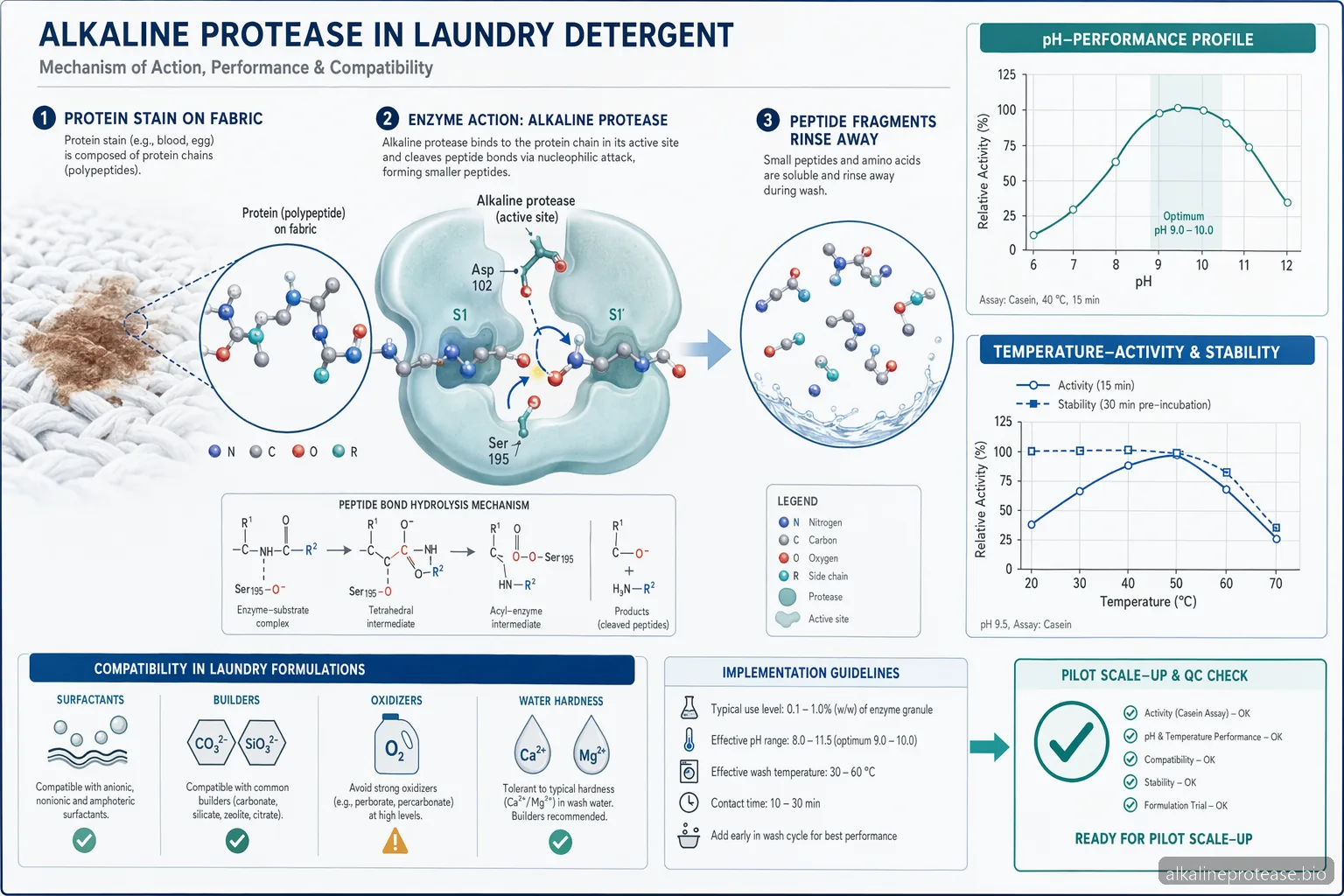
Dosage Guidance for Powder and Liquid Detergents
Alkaline protease application rates depend on enzyme activity, formulation format, target claims, and expected wash dose. As a starting point, formulators often screen protease granules in powder detergents at about 0.2–1.0% as supplied, then adjust based on activity units, stain performance, and cost-in-use. Liquid detergents may use lower or different inclusion levels, such as 0.05–0.5% as supplied, but stability can be more challenging because the enzyme is continuously exposed to the full formulation. These bands are only development ranges, not universal specifications. The correct dosage is established by comparing incremental stain removal against enzyme cost, storage loss, and processing risk. Include a no-enzyme control, a benchmark enzyme if available, and at least three dosage points. Confirm that any performance gain remains visible after accelerated and real-time storage.
Powder screening range: about 0.2–1.0% as supplied • Liquid screening range: about 0.05–0.5% as supplied • Use activity-normalized comparisons where possible • Optimize for cost-in-use, not maximum dosage
Compatibility with Detergent Ingredients
A successful application of alkaline protease requires compatibility across the complete detergent formulation. Anionic and nonionic surfactants, builders, enzymes, salts, solvents, optical brighteners, fragrances, preservatives, and anti-redeposition polymers can all influence enzyme performance. Bleaching systems require special attention because oxidants may reduce protease activity unless the enzyme is protected, physically separated, or added in a compatible format. In powders, coated or encapsulated enzyme granules can reduce dusting and improve stability; in liquids, stabilizer systems may include polyols, calcium salts, borates where permitted, or alternative stabilizing chemistry depending on regulatory and market constraints. Do not assume compatibility from ingredient lists alone. Measure residual protease activity after storage and connect it to real washing performance. The final decision should be based on stain removal, fabric safety, enzyme stability, processing feasibility, and occupational handling controls.
Check compatibility with surfactants and builders • Evaluate oxidizing bleach exposure carefully • Use low-dust granules where appropriate • Measure residual activity after storage
Pilot Validation and QC Checks Before Scale-Up
Before committing to commercial production, run pilot batches under the same mixing sequence, temperature, shear, moisture, and hold times expected at scale. Alkaline protease can lose activity through heat, prolonged high-pH exposure, oxidants, or unsuitable liquid matrices. QC should include enzyme activity assay at the target pH and temperature, appearance, odor, moisture for powders, pH of liquid detergent, viscosity where relevant, and microbial or preservative checks according to your product category. Performance testing should use standardized protein stain swatches such as blood, milk, egg, grass, or body soil, plus fabric compatibility checks. Compare fresh product with samples aged under accelerated and ambient conditions. A practical validation plan links residual activity to wash performance and cost-in-use, rather than approving the enzyme only because the incoming COA meets specification.
Run pilot batches using production-like conditions • Test fresh, accelerated-aged, and ambient-aged samples • Use protein stain swatches for performance validation • Link activity retention to cleaning performance
Supplier Qualification for Industrial Enzyme Buyers
For B2B sourcing, alkaline protease selection should include both technical and commercial qualification. Request the COA for recent batches, TDS with activity definition and recommended conditions, SDS for safe handling, allergen or occupational exposure guidance where applicable, and documentation of batch-to-batch consistency. Ask whether the product is a powder, granule, or liquid concentrate; whether it is intended for detergent use; and how it should be stored and transported. Evaluate lead time, packaging, minimum order quantity, sample availability, and support for formulation troubleshooting. Supplier qualification should also include incoming inspection criteria, retention samples, change notification expectations, and complaint response process. The lowest unit price is not always the best option if activity is unstable, dusting is high, or dosage must be increased. Use pilot data to calculate cost-in-use per wash or per ton of detergent.
Request COA, TDS, and SDS before approval • Confirm detergent-grade suitability • Review batch consistency and change notification • Compare suppliers by cost-in-use and validated performance
Technical Buying Checklist
Buyer Questions
The main application of alkaline protease in laundry detergent is the removal of protein-based stains. It hydrolyzes proteins in soils such as blood, egg, milk, grass, sweat, and body residues, making them easier for surfactants to disperse and rinse away. For industrial formulation, the enzyme must be tested in the complete detergent matrix, not only in buffer, because pH, surfactants, builders, and storage conditions affect performance.
Start with a dosage ladder based on the supplier’s activity and format. Powder detergents may begin around 0.2–1.0% as supplied, while liquid detergents may begin around 0.05–0.5% as supplied. Run stain-wash tests against a no-enzyme control and calculate cost-in-use. The best dosage is the lowest level that delivers consistent protein stain removal after realistic storage and wash conditions.
Subtilisin is a well-known family of serine proteases, and many detergent alkaline proteases are subtilisin-type enzymes. However, alkaline protease is a broader functional term describing proteases that work under alkaline conditions. For procurement, do not rely only on the enzyme name. Review the TDS, activity assay, pH and temperature profile, detergent compatibility, granule or liquid format, and actual wash performance data.
Request a current COA for batch-specific quality results, a TDS describing activity, recommended pH and temperature, dosage guidance, and storage conditions, plus an SDS for safe handling. For supplier qualification, also ask about batch consistency, change notification, packaging, shelf life, sample availability, and technical support. Final approval should be based on pilot validation and cost-in-use in your own detergent formula.
It can be used in some bleach-containing detergent systems, but compatibility must be proven. Oxidizing agents can reduce protease activity, especially during storage or direct contact in concentrated formulations. Powder detergents may use coated enzyme granules or physical separation strategies. Liquid systems are more challenging. Always test residual activity and stain performance after accelerated and real-time aging before approving a bleach-compatible formula.
Alkaline Protease for Research & Industry
Need Alkaline Protease for your lab or production process?
ISO 9001 certified · Food-grade & research-grade · Ships to 80+ countries
Frequently Asked Questions
What is the main application of alkaline protease in laundry detergent?
The main application of alkaline protease in laundry detergent is the removal of protein-based stains. It hydrolyzes proteins in soils such as blood, egg, milk, grass, sweat, and body residues, making them easier for surfactants to disperse and rinse away. For industrial formulation, the enzyme must be tested in the complete detergent matrix, not only in buffer, because pH, surfactants, builders, and storage conditions affect performance.
How do I choose the right alkaline protease enzyme dosage?
Start with a dosage ladder based on the supplier’s activity and format. Powder detergents may begin around 0.2–1.0% as supplied, while liquid detergents may begin around 0.05–0.5% as supplied. Run stain-wash tests against a no-enzyme control and calculate cost-in-use. The best dosage is the lowest level that delivers consistent protein stain removal after realistic storage and wash conditions.
Is subtilisin the same as alkaline protease?
Subtilisin is a well-known family of serine proteases, and many detergent alkaline proteases are subtilisin-type enzymes. However, alkaline protease is a broader functional term describing proteases that work under alkaline conditions. For procurement, do not rely only on the enzyme name. Review the TDS, activity assay, pH and temperature profile, detergent compatibility, granule or liquid format, and actual wash performance data.
What documents should an industrial buyer request from an alkaline protease supplier?
Request a current COA for batch-specific quality results, a TDS describing activity, recommended pH and temperature, dosage guidance, and storage conditions, plus an SDS for safe handling. For supplier qualification, also ask about batch consistency, change notification, packaging, shelf life, sample availability, and technical support. Final approval should be based on pilot validation and cost-in-use in your own detergent formula.
Can alkaline protease be used with bleach-containing detergents?
It can be used in some bleach-containing detergent systems, but compatibility must be proven. Oxidizing agents can reduce protease activity, especially during storage or direct contact in concentrated formulations. Powder detergents may use coated enzyme granules or physical separation strategies. Liquid systems are more challenging. Always test residual activity and stain performance after accelerated and real-time aging before approving a bleach-compatible formula.
Related: Alkaline Protease for Detergent and Laundry Formulation
Turn This Guide Into a Supplier Brief Request detergent-grade alkaline protease samples, COA/TDS/SDS, and pilot support for your laundry formulation. See our application page for Alkaline Protease for Detergent and Laundry Formulation at /applications/alkaline-protease-detergent-laundry/ for specs, MOQ, and a free 50 g sample.
Contact Us to Contributehello@mail.alkalineprotease.bio