Alkaline Protease Application: Specification Checklist for Laundry Detergent
Compare alkaline protease specs for laundry detergent: pH, temperature, dosage, stability, COA/TDS/SDS, pilot trials, and supplier checks.
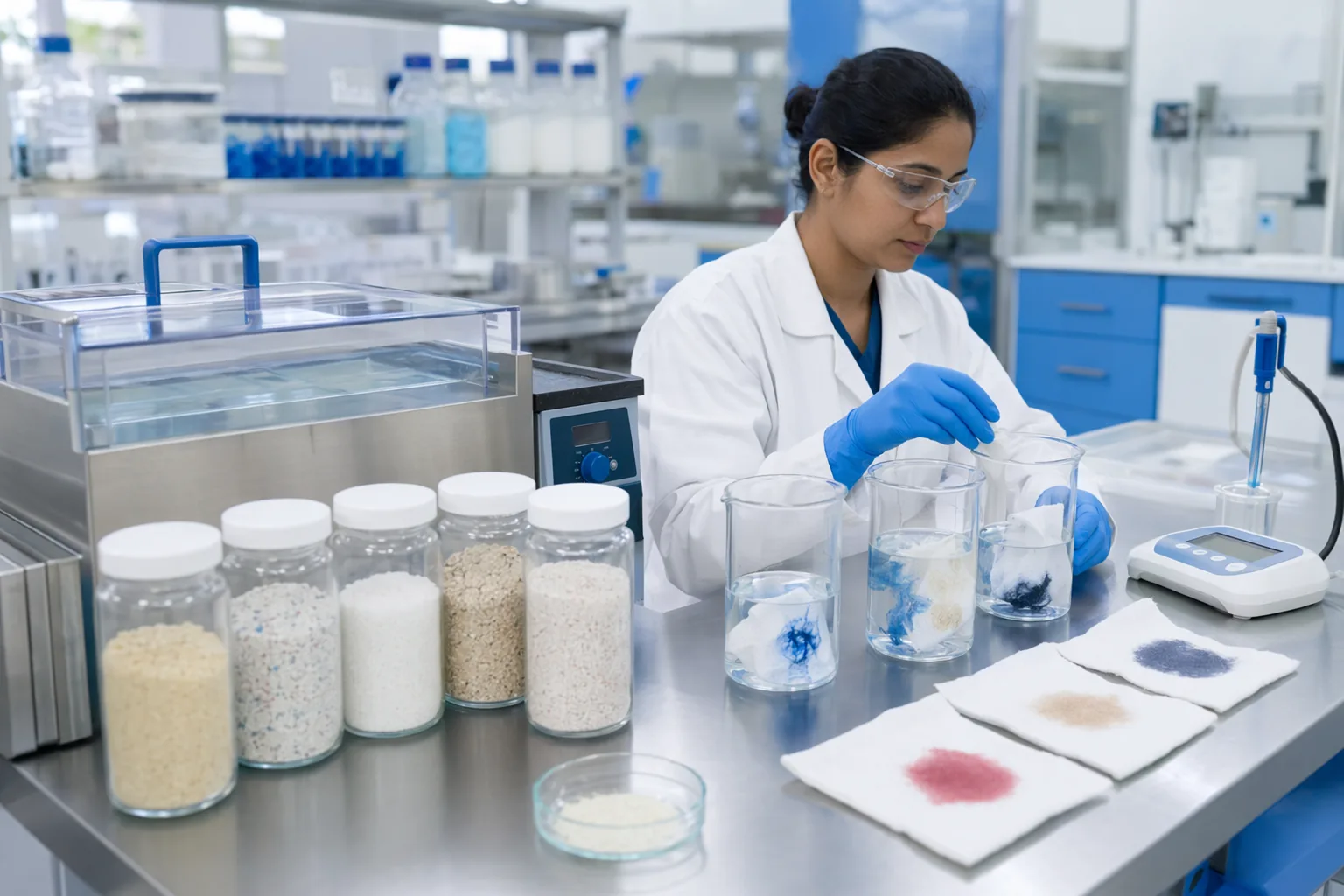
For detergent formulators, the right alkaline protease is not just a high-activity enzyme. It must match wash pH, surfactants, builders, temperature profile, processing route, and cost-in-use targets.
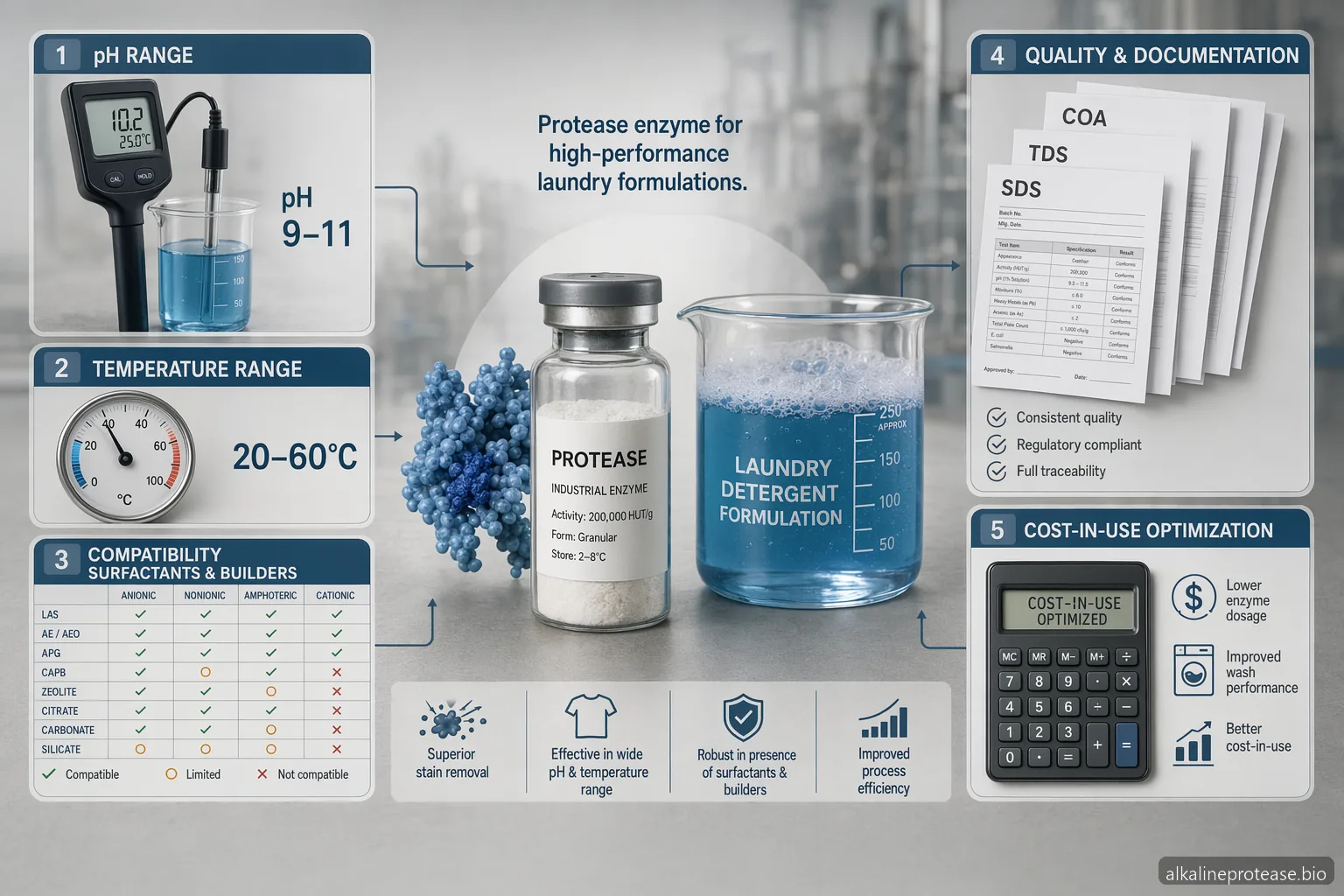
What Is Alkaline Protease in Detergent Formulation?
Alkaline protease is a protein-hydrolyzing enzyme that performs under alkaline washing conditions, helping break down proteinaceous soils such as blood, egg, milk, grass, sweat, and food residues. In laundry detergent, the most common industrial options are bacterial alkaline protease products, often based on alkaline serine protease chemistry such as subtilisin. For B2B buyers, the main question is not simply what is alkaline protease, but which grade fits a powder, liquid, tablet, or unit-dose system. The application of alkaline protease enzyme in detergents depends on wash pH, temperature, contact time, water hardness, surfactant package, oxidant exposure, and storage format. A high headline activity can underperform if it is unstable in the formulation or releases too quickly during processing. A specification checklist helps procurement, R&D, and QA compare suppliers using measurable criteria rather than generic claims.
Typical detergent wash pH target: about 8.5–11.0 • Common wash temperature range: 20–60 °C • Primary value driver: protein stain removal at low cost-in-use
Compare Enzyme Type, Form, and Activity Basis
When comparing alkaline protease application options, first align the enzyme type and activity basis. Powder detergents commonly use coated granular alkaline protease to reduce dust, improve handling, and protect activity during storage. Liquid detergents may require stabilized liquid protease, but compatibility must be checked against water activity, solvents, preservatives, surfactants, and chelants. Activity units are not universal across suppliers, so do not compare only the number on the TDS. Request the assay method, substrate, pH, temperature, incubation time, and unit definition. Alkaline protease producing bacteria, production strain class, and downstream purification can influence side activities, odor, color, and consistency. For detergent benchmarking, compare stain panel performance at equal cost-in-use and equal finished-product dosage, not only equal enzyme activity. This is the most practical way to distinguish a robust bacterial alkaline protease from a less suitable grade.
Confirm granular, liquid, or encapsulated format • Normalize activity units before price comparison • Benchmark at equal cost-in-use, not only equal dosage • Check for unwanted side activities or formulation odor
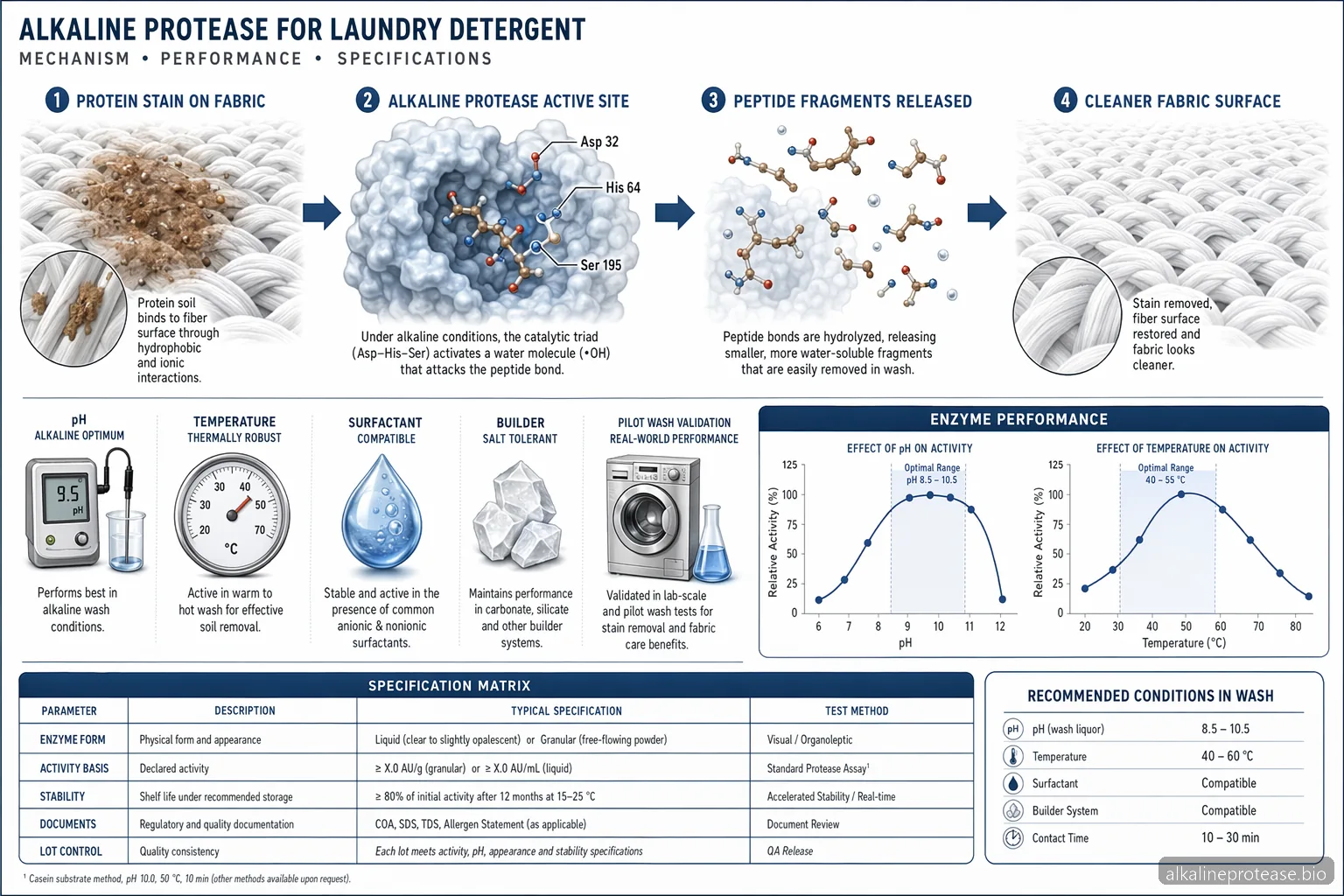
Process Conditions to Specify Before Sampling
A detergent alkaline protease specification should be written around real process conditions. For powders, confirm tolerance to post-dosing, blending shear, moisture pickup, and storage at elevated warehouse temperatures. For liquids, test enzyme survival in the finished formula over time, not only in buffer. Many laundry systems require good activity between pH 8.5 and 10.5, with useful performance from cool wash conditions around 20–30 °C through warm wash conditions around 40–60 °C. The starting dosage band for trials is often 0.2–1.0% coated granule in powder detergent, or supplier-equivalent liquid dosage, adjusted for activity, formulation strength, and market positioning. If bleach, percarbonate, TAED, high pH builders, zeolite, carbonate, nonionic surfactants, anionic surfactants, or chelants are present, compatibility should be measured under the exact formulation and storage conditions.
Trial pH: 8.5, 9.5, 10.5, and 11.0 where relevant • Trial temperature: 20, 30, 40, and 60 °C • Initial powder dosage screen: 0.2–1.0% coated granule • Storage screen: 4, 25, 35, and 40 °C when applicable
QC Documents: COA, TDS, SDS, and Lot Controls
Supplier comparison should include technical documentation before commercial negotiation. The COA should report lot number, activity, appearance, moisture or solids, microbiological limits where relevant, and any agreed customer-specific parameters. The TDS should describe enzyme form, recommended pH and temperature ranges, dosage guidance, compatibility notes, storage conditions, shelf life, and assay method. The SDS should address safe handling, respiratory sensitization risk, PPE, spill cleanup, transport classification, and disposal guidance. For industrial enzyme procurement, also request allergen-control handling recommendations, dust data for granules, retained sample policy, change-notification practice, and traceability. If a supplier cannot explain the difference between assay activity and detergent cleaning performance, the risk is high. Qualification should include at least three lots where possible to confirm lot-to-lot consistency before locking a formula.
COA: activity, appearance, lot number, moisture or solids • TDS: assay method, dosage, pH, temperature, storage • SDS: safe handling and respiratory sensitization controls • QA: retained samples and change-notification process
Pilot Validation for Laundry Performance
Pilot validation converts an application of alkaline protease into a purchasing decision. Build a test matrix using your actual base detergent, target water hardness, wash temperature, liquor ratio, wash time, and fabric load. Compare the candidate alkaline protease against your current enzyme, a blank without protease, and any alternative enzyme blend. Use standardized protein stains and relevant local soils, then measure reflectance, visual grading, fabric damage, odor, and redeposition. Include storage-aged detergent samples, because fresh-formula performance can overstate real shelf-life value. For powders, test granule integrity, segregation, dust, and enzyme recovery after blending. For liquids, test viscosity, phase stability, pH drift, and residual activity during storage. Approve a supplier only after pilot data supports the dosage recommendation, cost-in-use, and consumer-relevant cleaning performance.
Include blank, incumbent, and candidate samples • Use fresh and aged detergent in wash trials • Measure stain removal and residual enzyme activity • Confirm physical stability of the finished detergent
Cost-in-Use and Supplier Qualification
The lowest enzyme price per kilogram is not necessarily the lowest detergent cost. Cost-in-use should include delivered price, activity retention in the formula, dosage needed to hit stain-removal targets, production losses, storage losses, rework risk, and handling controls. A concentrated subtilisin-based alkaline protease may be economical if it remains stable and allows lower dosage, while a cheaper grade may require higher addition or cause performance variability. Supplier qualification should review manufacturing capacity, batch consistency, technical service response, documentation quality, lead time, packaging integrity, and complaint handling. Ask whether the supplier can support pilot troubleshooting, reformulation, and scale-up. For strategic detergent programs, dual-source only after performance is normalized across equivalent assay methods and wash tests. This reduces supply risk without introducing hidden differences in cleaning performance or stability.
Calculate cost per effective wash, not only price per kg • Include storage stability and processing loss • Review capacity, lead time, and technical support • Qualify backup sources using the same pilot protocol
Technical Buying Checklist
Buyer Questions
The main alkaline protease application in laundry detergent is hydrolyzing protein soils under alkaline wash conditions. It helps remove stains from blood, egg, milk, sweat, grass, and food residues. For industrial buyers, performance should be evaluated in the finished detergent at the intended pH, temperature, water hardness, and storage age, not only by enzyme activity in a laboratory buffer.
Compare suppliers using the same detergent base, dosage basis, wash protocol, stain panel, and storage-aging conditions. Request COA, TDS, SDS, assay method, unit definition, and lot traceability. Then calculate cost-in-use from delivered price, dosage required, residual activity after storage, and stain-removal performance. A supplier with a higher price per kilogram may still be lower cost if activity retention is better.
A practical starting screen for coated granular alkaline protease in powder detergent is often about 0.2–1.0% of finished product. The final dosage depends on enzyme activity, granule concentration, stain-removal target, surfactant system, builders, storage stability, and price positioning. Always optimize through pilot wash tests and cost-in-use modeling rather than copying a generic dosage from another formula.
Subtilisin is a common type of alkaline serine protease used in detergents, but alkaline protease is the broader category. Different subtilisin variants and bacterial alkaline protease products can vary in pH profile, temperature response, surfactant tolerance, bleach sensitivity, and storage stability. Buyers should compare the specific commercial grade, assay method, and detergent performance rather than assuming all subtilisin products behave the same.
Searches for food-oriented alkaline protease can lead to grades designed for protein hydrolysis in food processing rather than detergent use. Detergent buyers should verify alkaline pH performance, surfactant compatibility, builder tolerance, bleach exposure, dust control, SDS handling requirements, and cost-in-use. A food-processing grade may not have the stability, format, or economics required for laundry detergent manufacturing.
Alkaline Protease for Research & Industry
Need Alkaline Protease for your lab or production process?
ISO 9001 certified · Food-grade & research-grade · Ships to 80+ countries
Frequently Asked Questions
What is the main alkaline protease application in laundry detergent?
The main alkaline protease application in laundry detergent is hydrolyzing protein soils under alkaline wash conditions. It helps remove stains from blood, egg, milk, sweat, grass, and food residues. For industrial buyers, performance should be evaluated in the finished detergent at the intended pH, temperature, water hardness, and storage age, not only by enzyme activity in a laboratory buffer.
How should I compare alkaline protease suppliers?
Compare suppliers using the same detergent base, dosage basis, wash protocol, stain panel, and storage-aging conditions. Request COA, TDS, SDS, assay method, unit definition, and lot traceability. Then calculate cost-in-use from delivered price, dosage required, residual activity after storage, and stain-removal performance. A supplier with a higher price per kilogram may still be lower cost if activity retention is better.
What dosage of alkaline protease is typical for powder detergent?
A practical starting screen for coated granular alkaline protease in powder detergent is often about 0.2–1.0% of finished product. The final dosage depends on enzyme activity, granule concentration, stain-removal target, surfactant system, builders, storage stability, and price positioning. Always optimize through pilot wash tests and cost-in-use modeling rather than copying a generic dosage from another formula.
Is subtilisin the same as alkaline protease?
Subtilisin is a common type of alkaline serine protease used in detergents, but alkaline protease is the broader category. Different subtilisin variants and bacterial alkaline protease products can vary in pH profile, temperature response, surfactant tolerance, bleach sensitivity, and storage stability. Buyers should compare the specific commercial grade, assay method, and detergent performance rather than assuming all subtilisin products behave the same.
Should detergent buyers consider food-grade alkaline protease?
Searches for food-oriented alkaline protease can lead to grades designed for protein hydrolysis in food processing rather than detergent use. Detergent buyers should verify alkaline pH performance, surfactant compatibility, builder tolerance, bleach exposure, dust control, SDS handling requirements, and cost-in-use. A food-processing grade may not have the stability, format, or economics required for laundry detergent manufacturing.
Related: Alkaline Protease for Detergent and Laundry Formulation
Turn This Guide Into a Supplier Brief Request a detergent-grade alkaline protease comparison pack with COA, TDS, SDS, dosage guidance, and pilot validation support. See our application page for Alkaline Protease for Detergent and Laundry Formulation at /applications/alkaline-protease-detergent-laundry/ for specs, MOQ, and a free 50 g sample.
Contact Us to Contributehello@mail.alkalineprotease.bio