Alkaline Protease for Laundry Detergent Manufacturing
Source alkaline protease for laundry detergent with pH, temperature, dosage, QC, COA/TDS/SDS, pilot validation, and cost-in-use guidance.

A practical B2B guide for detergent formulators sourcing alkaline protease enzyme for stain removal performance, formulation stability, and cost-in-use control.
What Is Alkaline Protease in Detergent Manufacturing?
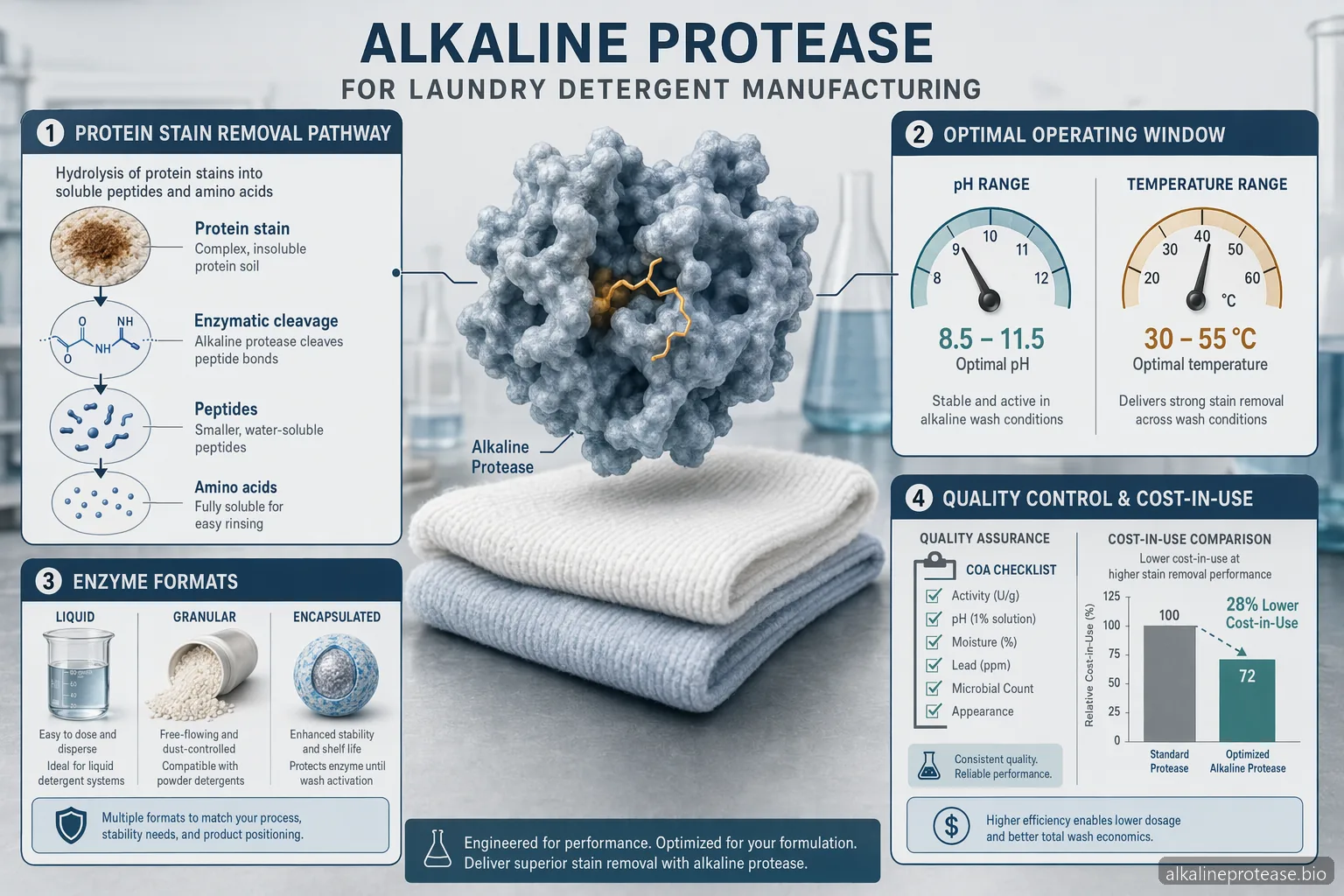
Alkaline protease is an enzyme that breaks peptide bonds in proteins under alkaline conditions. In laundry detergent, the alkaline protease function is to help remove proteinaceous stains that surfactants and builders alone may not fully disperse. Commercial detergent grades are often bacterial alkaline protease products, commonly from alkaline protease producing bacteria selected for secretion efficiency, alkaline stability, and manufacturability. Many products are alkaline serine protease enzymes, including subtilisin-type proteases, because they can perform well in high-pH detergent systems. For B2B buyers, the question is not only what is alkaline protease, but whether a specific grade remains active in the intended powder, liquid, unit-dose, or institutional wash formula. The supplier should define activity units, test method, carrier or solvent system, storage recommendations, and compatibility limitations. A purchasing decision should be based on validated wash performance, not activity units alone.
Target use: protein stain removal in laundry detergent • Common enzyme class: alkaline serine protease, including subtilisin-type enzymes • Typical evaluation: wash performance, formulation stability, and cost-in-use
Operating Conditions: pH, Temperature, and Dosage
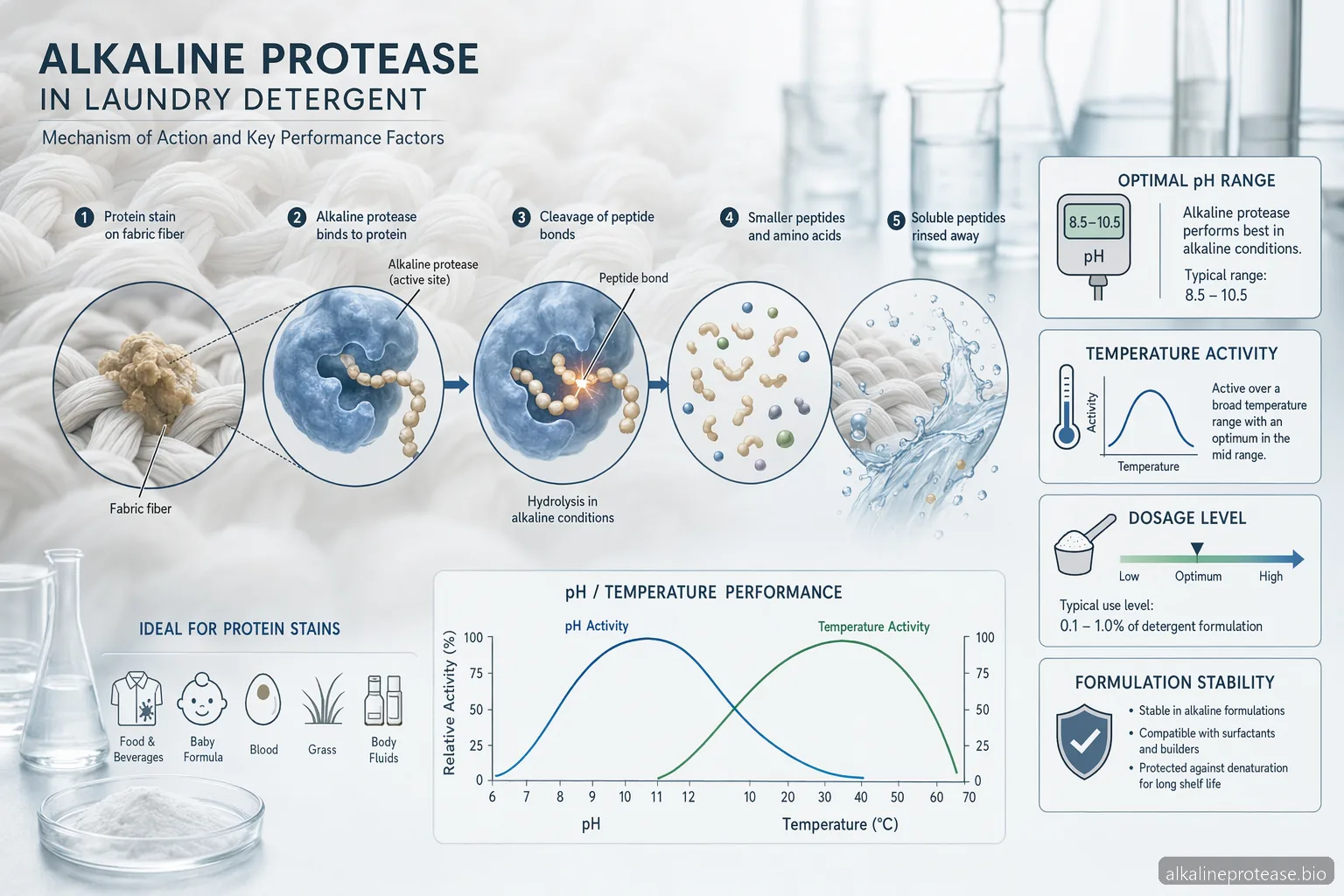
Detergent alkaline protease should be screened under realistic wash and storage conditions. Many detergent systems operate near pH 9-11 in use, while compact liquids and unit-dose products may expose the enzyme to concentrated surfactants, solvents, builders, chelants, and fragrance components before dilution. Wash temperature targets often range from 20-60°C, depending on the market and detergent format. Initial dosage trials may start around 0.1-1.0% of a formulated enzyme preparation in finished detergent, but the correct dose depends on enzyme activity, product form, stain panel, wash liquor concentration, and price per kilogram. For industrial and institutional laundry, dosage may be optimized per wash load or ppm active enzyme in wash liquor. Avoid relying on generic dosage claims. Run stepwise trials against a control detergent, then confirm the lowest dose that delivers consistent stain removal and acceptable shelf life.
Common use pH screening: pH 9-11 • Typical wash temperature screening: 20-60°C • Trial dosage band: often 0.1-1.0% of enzyme preparation in finished detergent • Optimize by performance and cost-in-use, not label activity alone
Choosing Liquid, Granular, or Encapsulated Protease
Alkaline protease solution products are often considered for liquid detergents because they can be metered easily and dispersed uniformly. However, liquid formulations require careful stability work because water activity, surfactant concentration, pH, solvents, salts, and preservatives can affect enzyme retention. Granular or encapsulated protease formats are widely used in powders because coatings can reduce dusting, improve handling, and help separate the enzyme from incompatible components during storage. Buyers should ask whether the grade is designed for powder detergent, liquid detergent, or both. A supplier’s TDS should specify appearance, activity range, recommended storage, pH and temperature profile, and known compatibility considerations. For worker safety, review the SDS and handling recommendations, especially for dust and aerosol exposure. The best form is the one that gives stable activity, safe handling, and consistent dosing in your manufacturing process.
Liquid grades: easy metering, but stability must be proven • Granular grades: common for powders and dust-controlled handling • Encapsulated grades: useful where separation and storage protection are needed • Always confirm compatibility in the actual detergent base
Quality Control, COA Review, and Supplier Qualification
Supplier qualification for alkaline protease production should combine documentation review, incoming QC, and performance validation. Each batch should ship with a COA showing product name, batch number, activity result, method reference, manufacturing or release date, shelf-life guidance, and relevant physical specifications. The TDS should explain recommended use conditions, while the SDS should support safe storage, handling, spill response, and transport classification. Incoming QC may include activity verification, appearance, odor, moisture or solids, pH of solution where applicable, microbial limits if relevant to the buyer’s quality system, and packaging integrity. Buyers should also assess batch-to-batch consistency, lead time, change-control communication, technical support, and sample availability. Supplier audits or questionnaires can confirm traceability, process controls, contamination prevention, and complaint handling. Qualification is complete only when documentation and plant trials both support commercial use.
Request COA, TDS, SDS, activity method, and batch traceability • Verify activity and appearance on receipt • Assess change control, lead time, and technical support • Use pilot results before locking commercial specifications
Pilot Validation and Cost-in-Use for Laundry Formulators
A pilot program should compare candidate alkaline protease enzyme grades under the same detergent matrix, wash protocol, fabric type, water hardness, soil load, and temperature. Start with a no-enzyme control, then test several enzyme doses to build a response curve. Use standardized protein stain panels when available, but also include market-relevant stains such as blood, dairy, egg, grass, and mixed food residues. Measure stain removal, whiteness maintenance, fabric impact, foam changes, odor, viscosity, and storage stability. For liquid detergents, run accelerated and real-time stability to track retained activity and product appearance. For powders, evaluate segregation, dust, caking, and activity retention after storage. Cost-in-use should include enzyme price, effective dose, retained activity through shelf life, production handling, waste, and claims support. The winning enzyme is the grade that delivers the required wash performance at the lowest validated system cost.
Run no-enzyme controls and dose-response trials • Use real detergent matrix and local wash conditions • Track retained activity after storage • Calculate cost-in-use from effective performance, not purchase price alone
Technical Buying Checklist
Buyer Questions
Alkaline protease is used to hydrolyze protein-based stains during washing. It helps break down blood, egg, milk, grass, sweat, and food residues into smaller fragments that are easier for surfactants and mechanical action to remove. For detergent buyers, the main evaluation criteria are stain removal at the intended pH and temperature, compatibility with the formula, and retained activity during shelf life.
Select a supplier that can provide samples, COA, TDS, SDS, activity method, batch traceability, shelf-life guidance, and technical support for your detergent format. Ask about batch consistency, lead time, change-control communication, and packaging options. Final approval should depend on pilot validation in your own detergent base and wash protocol, not only on quoted enzyme activity or unit price.
A practical first screening range is often 0.1-1.0% of the formulated enzyme preparation in finished detergent, but the correct dosage varies by activity, enzyme form, detergent concentration, wash temperature, water hardness, and stain target. Industrial laundries may optimize by wash-load dosage or ppm in wash liquor. Build a dose-response curve and select the lowest dose that meets performance and stability requirements.
Yes, alkaline protease solution products can be used in liquid detergent, but stability must be confirmed. Concentrated liquid formulas may contain surfactants, solvents, salts, preservatives, fragrances, or pH conditions that reduce retained activity over time. Test both accelerated and real-time storage, then compare enzyme activity, viscosity, odor, appearance, and stain removal after aging before making a commercial purchase.
Not always. Many commercial detergent proteases are bacterial alkaline protease products, and a large group are subtilisin-type alkaline serine proteases. However, suppliers may offer different strains, variants, activity profiles, and product forms. Buyers should review the technical data sheet and test actual performance under detergent conditions rather than assuming all bacterial proteases or subtilisin-type enzymes behave identically.
Alkaline Protease for Research & Industry
Need Alkaline Protease for your lab or production process?
ISO 9001 certified · Food-grade & research-grade · Ships to 80+ countries
Frequently Asked Questions
What is alkaline protease used for in laundry detergent?
Alkaline protease is used to hydrolyze protein-based stains during washing. It helps break down blood, egg, milk, grass, sweat, and food residues into smaller fragments that are easier for surfactants and mechanical action to remove. For detergent buyers, the main evaluation criteria are stain removal at the intended pH and temperature, compatibility with the formula, and retained activity during shelf life.
How should we select an alkaline protease supplier?
Select a supplier that can provide samples, COA, TDS, SDS, activity method, batch traceability, shelf-life guidance, and technical support for your detergent format. Ask about batch consistency, lead time, change-control communication, and packaging options. Final approval should depend on pilot validation in your own detergent base and wash protocol, not only on quoted enzyme activity or unit price.
What dosage of alkaline protease is typical in detergents?
A practical first screening range is often 0.1-1.0% of the formulated enzyme preparation in finished detergent, but the correct dosage varies by activity, enzyme form, detergent concentration, wash temperature, water hardness, and stain target. Industrial laundries may optimize by wash-load dosage or ppm in wash liquor. Build a dose-response curve and select the lowest dose that meets performance and stability requirements.
Can alkaline protease be used in liquid detergent?
Yes, alkaline protease solution products can be used in liquid detergent, but stability must be confirmed. Concentrated liquid formulas may contain surfactants, solvents, salts, preservatives, fragrances, or pH conditions that reduce retained activity over time. Test both accelerated and real-time storage, then compare enzyme activity, viscosity, odor, appearance, and stain removal after aging before making a commercial purchase.
Is bacterial alkaline protease the same as subtilisin?
Not always. Many commercial detergent proteases are bacterial alkaline protease products, and a large group are subtilisin-type alkaline serine proteases. However, suppliers may offer different strains, variants, activity profiles, and product forms. Buyers should review the technical data sheet and test actual performance under detergent conditions rather than assuming all bacterial proteases or subtilisin-type enzymes behave identically.
Related: Alkaline Protease for Detergent and Laundry Formulation
Turn This Guide Into a Supplier Brief Request detergent-grade alkaline protease samples, COA/TDS/SDS, and pilot trial support for your laundry formulation. See our application page for Alkaline Protease for Detergent and Laundry Formulation at /applications/alkaline-protease-detergent-laundry/ for specs, MOQ, and a free 50 g sample.
Contact Us to Contributehello@mail.alkalineprotease.bio