Detergent Enzymes: How to Use Alkaline Protease in Laundry Detergent Formulations
How detergent enzymes like alkaline protease work in laundry detergent formulation: pH, dosage, QC, stability, COA/TDS/SDS, pilot trials, cost-in-use.

A practical B2B guide to detergent enzymes for manufacturers selecting, dosing, stabilizing, and validating alkaline protease for protein-stain removal in laundry products.
Why Alkaline Protease Is Used in Laundry Detergent
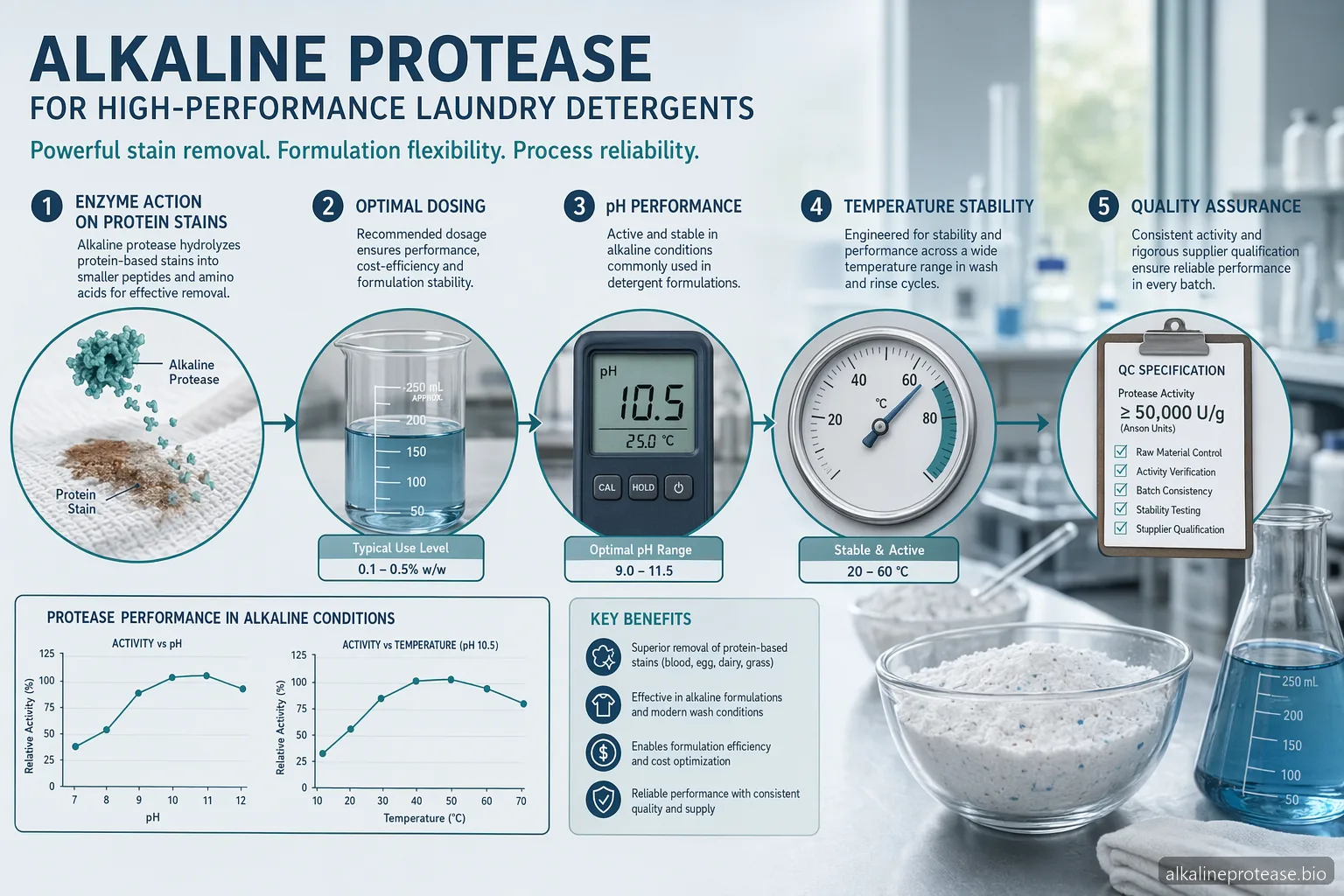
Alkaline protease is a workhorse enzyme for laundry detergent because it hydrolyzes protein-based stains such as blood, egg, milk, grass, and body soil under mildly to strongly alkaline wash conditions. In B2B detergent development, the objective is not simply to add enzyme, but to deliver measurable stain removal across realistic water hardness, temperature, fabric, and wash-time conditions. Subtilisin-type alkaline protease enzyme grades are commonly selected for powder, liquid, tablet, and unit-dose products when the formulation pH, moisture level, and oxidant system are compatible. For an industrial alkaline protease laundry detergent project, buyers should compare activity, stability, and cost-in-use in the finished formula, not just quoted price per kilogram. A robust screening plan includes control detergent, enzyme-only variation, full formula variation, accelerated storage, and consumer-relevant wash testing. Alkaline protease is one of the most widely used detergent enzymes in the industry, alongside amylase and lipase, and it is often the enzyme that does the most work against everyday protein-based stains.
Primary benefit: protein stain removal • Common enzyme family: subtilisin-type serine protease • Best evaluated in the complete detergent matrix • Useful in both economy and premium detergent segments
Recommended Formulation Conditions
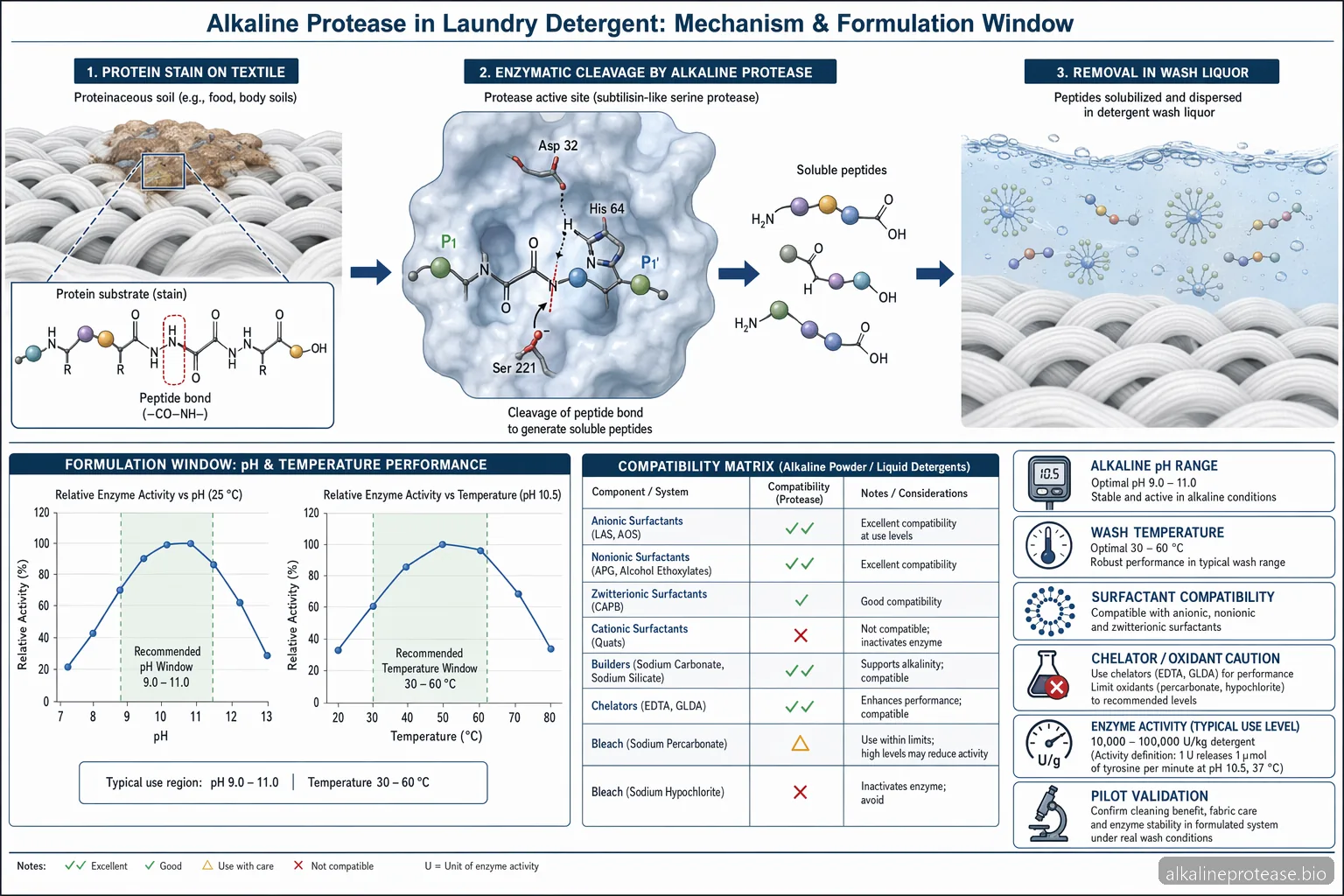
Most detergent alkaline protease products are designed to operate in alkaline wash liquor, commonly around pH 8.5 to 11.0, with practical wash temperatures from 20°C to 60°C depending on the enzyme grade. For initial formulation work, many manufacturers screen liquid or granular enzyme at low inclusion levels, then convert the result into activity per dose, activity per wash, and cost per wash. Exact dosage should be based on the supplier TDS, declared activity unit, enzyme recovery after storage, and stain panel results. As a starting point, formulators often test several enzyme concentrations across low, medium, and high soil loads instead of relying on a single recommended dose. This is especially important for industrial alkaline protease enzyme laundry detergent where builders, chelants, surfactants, and bleaching systems can shift the final enzyme performance.
Screen pH: 8.5-11.0 where compatible with the product • Screen wash temperature: 20-60°C • Dose by activity contribution, not only by mass percentage • Validate in local water hardness and wash equipment
Compatibility With Detergent Ingredients
Alkaline protease detergent stability is strongly influenced by the surrounding formulation. Nonionic and anionic surfactants may be compatible, but compatibility must be confirmed because surfactant type, concentration, solvent load, water activity, and pH all matter. Builders and chelants can improve cleaning but may alter calcium balance and enzyme structure. Oxidizing bleaches, high pH liquids, high water content, and reactive fragrance components can reduce enzyme activity during storage. In powders, granulated protease is often selected to improve handling and reduce dust; in liquids, stabilized enzyme preparations may be needed to maintain activity over the declared shelf life. The development question is therefore not whether alkaline protease can work, but whether the selected enzyme remains active after manufacturing, filling, warehousing, and use by the customer.
Check compatibility with surfactants, builders, chelants, solvents, and fragrance • Run storage at ambient and accelerated temperatures • Measure residual activity after storage, not only initial activity • Control dust exposure when handling enzyme granulates
QC Checks, Activity Units, and Documentation
Every shipment of industrial alkaline protease detergent material should be supported by a COA, TDS, and SDS. The COA should state batch number, activity, appearance, moisture or solids where relevant, microbial limits if specified, and release date. The TDS should define activity method, recommended pH and temperature range, formulation cautions, storage conditions, and shelf-life guidance. Because enzyme activity units are method-dependent, the buyer and supplier must align on the assay before comparing offers. If an internal team references a detergent alkaline protease unit JECFA or another published unit definition, confirm substrate, pH, temperature, incubation time, calculation basis, and whether the result is directly comparable to the supplier unit. For incoming QC, retain samples, verify appearance and activity, and track performance trends across production lots.
Request COA, TDS, and SDS before approval • Confirm the exact activity assay and unit definition • Use retained samples for dispute resolution • Trend activity and performance by batch
Pilot Validation and Cost-in-Use
A practical pilot program links enzyme dosage to measurable stain removal, finished-product stability, processing behavior, and cost-in-use. Begin with laboratory beaker or tergotometer tests, then move to pilot blending, packaging, storage, and wash performance under local use conditions. Include negative controls, benchmark detergent, and at least three enzyme dose levels. For powder production, observe granule integrity, segregation, flow, and dust. For liquid production, track viscosity, pH drift, clarity, odor, and residual activity. Cost-in-use should include enzyme price, active contribution, loss during storage, required stabilizers, packaging impact, freight, minimum order quantity, and rejected-batch risk. This approach helps industrial buyers identify the best alkaline protease detergent option for total value rather than selecting the lowest invoice price.
Compare stain removal against a no-enzyme control • Use three or more dose levels in pilot trials • Calculate cost per wash or cost per finished tonne • Include storage losses in the economic model
Supplier Qualification for Industrial Buyers
Supplier qualification should combine technical, quality, commercial, and operational checks. Ask for representative samples, COA/TDS/SDS, recommended storage conditions, allergen and respiratory sensitization handling guidance, packaging options, batch-to-batch activity history, and change-control expectations. A qualified supplier should help translate laboratory activity into detergent performance and should support troubleshooting if activity drops in the finished product. For industrial alkaline protease detergent laundry detergent programs, confirm lead time, shelf life at receipt, temperature exposure during shipping, and whether the supplier can provide consistent grade availability as volumes scale. If your company also evaluates industrial alkaline protease detergent leather processing or industrial alkaline protease detergent silk degumming, keep those application trials separate because pH, substrate, temperature, and impurity tolerances may differ from laundry detergent requirements.
Qualify technical support as well as price • Confirm packaging, shelf life, and logistics • Document change-control expectations • Separate laundry, leather, and silk validation protocols
Technical Buying Checklist
Buyer Questions
There is no universal dosage because enzyme activity units, formulation format, stain target, water hardness, and storage loss vary. Start with the supplier TDS recommendation, then test at low, medium, and high activity levels in the finished detergent. Convert results into activity per wash and cost per wash. Final dosage should be justified by stain removal, shelf-life stability, processing behavior, and cost-in-use.
Yes, alkaline protease can be used in both formats, but the selected grade and stabilization strategy may differ. Powders often use granulated enzyme to improve flow and reduce dust. Liquids may require enzyme-stabilized preparations and careful control of pH, water activity, solvents, and preservatives. Each format needs separate storage testing and residual activity measurement before commercial approval.
Do not compare activity numbers unless the assay method is aligned. Activity depends on substrate, pH, temperature, incubation time, calculation basis, and reporting unit. If a purchasing specification mentions detergent alkaline protease unit JECFA, confirm whether that method is applicable to the detergent grade and whether supplier units can be converted. Performance testing in the final detergent remains essential.
It may be possible, but bleach compatibility must be proven for the exact formula. Oxidizing systems can reduce protease activity during storage or in the wash, depending on bleach type, activator, pH, moisture, and contact time. Run accelerated and ambient storage tests with residual activity checks, then confirm stain removal. If activity loss is high, consider formulation changes, enzyme granulation, or staged dosing.
Request a COA for the supplied batch, a TDS with activity method and recommended use conditions, and an SDS with handling and exposure guidance. Also ask for storage instructions, shelf-life statement, packaging details, representative sample availability, and change-control expectations. For supplier qualification, review batch consistency, technical support capability, logistics reliability, and pilot validation results in your own detergent formula.
A flow chart for alkaline protease producing bacteria from detergent soil may help R&D teams understand strain screening, isolation, fermentation, and purification concepts, but procurement teams should focus on commercial-grade consistency and documentation. A flow chart for alkaline protease activity from contaminated detergent can support troubleshooting, yet finished-product validation still requires controlled assays, retained samples, and wash performance data.
Alkaline Protease for Research & Industry
Need Alkaline Protease for your lab or production process?
ISO 9001 certified · Food-grade & research-grade · Ships to 80+ countries
Frequently Asked Questions
What dosage of alkaline protease should be used in laundry detergent?
There is no universal dosage because enzyme activity units, formulation format, stain target, water hardness, and storage loss vary. Start with the supplier TDS recommendation, then test at low, medium, and high activity levels in the finished detergent. Convert results into activity per wash and cost per wash. Final dosage should be justified by stain removal, shelf-life stability, processing behavior, and cost-in-use.
Is alkaline protease suitable for both powder and liquid detergent?
Yes, alkaline protease can be used in both formats, but the selected grade and stabilization strategy may differ. Powders often use granulated enzyme to improve flow and reduce dust. Liquids may require enzyme-stabilized preparations and careful control of pH, water activity, solvents, and preservatives. Each format needs separate storage testing and residual activity measurement before commercial approval.
How should activity units be compared between suppliers?
Do not compare activity numbers unless the assay method is aligned. Activity depends on substrate, pH, temperature, incubation time, calculation basis, and reporting unit. If a purchasing specification mentions detergent alkaline protease unit JECFA, confirm whether that method is applicable to the detergent grade and whether supplier units can be converted. Performance testing in the final detergent remains essential.
Can alkaline protease be used with bleach in detergent?
It may be possible, but bleach compatibility must be proven for the exact formula. Oxidizing systems can reduce protease activity during storage or in the wash, depending on bleach type, activator, pH, moisture, and contact time. Run accelerated and ambient storage tests with residual activity checks, then confirm stain removal. If activity loss is high, consider formulation changes, enzyme granulation, or staged dosing.
What documents should an industrial buyer request before approval?
Request a COA for the supplied batch, a TDS with activity method and recommended use conditions, and an SDS with handling and exposure guidance. Also ask for storage instructions, shelf-life statement, packaging details, representative sample availability, and change-control expectations. For supplier qualification, review batch consistency, technical support capability, logistics reliability, and pilot validation results in your own detergent formula.
Are flow charts useful for detergent protease development?
A flow chart for alkaline protease producing bacteria from detergent soil may help R&D teams understand strain screening, isolation, fermentation, and purification concepts, but procurement teams should focus on commercial-grade consistency and documentation. A flow chart for alkaline protease activity from contaminated detergent can support troubleshooting, yet finished-product validation still requires controlled assays, retained samples, and wash performance data.
Related: Alkaline Protease for Detergent and Laundry Formulation
Turn This Guide Into a Supplier Brief Request alkaline protease detergent samples, COA/TDS/SDS, and pilot formulation support for your laundry detergent project. See our application page for Alkaline Protease for Detergent and Laundry Formulation at /applications/alkaline-protease-detergent-laundry/ for specs, MOQ, and a free 50 g sample.
Contact Us to Contributehello@mail.alkalineprotease.bio