Alkaline Protease Production for Industrial Buyers
Plan industrial alkaline protease production with strain, media, fermentation, downstream processing, QC, pilot validation, and supplier checks.
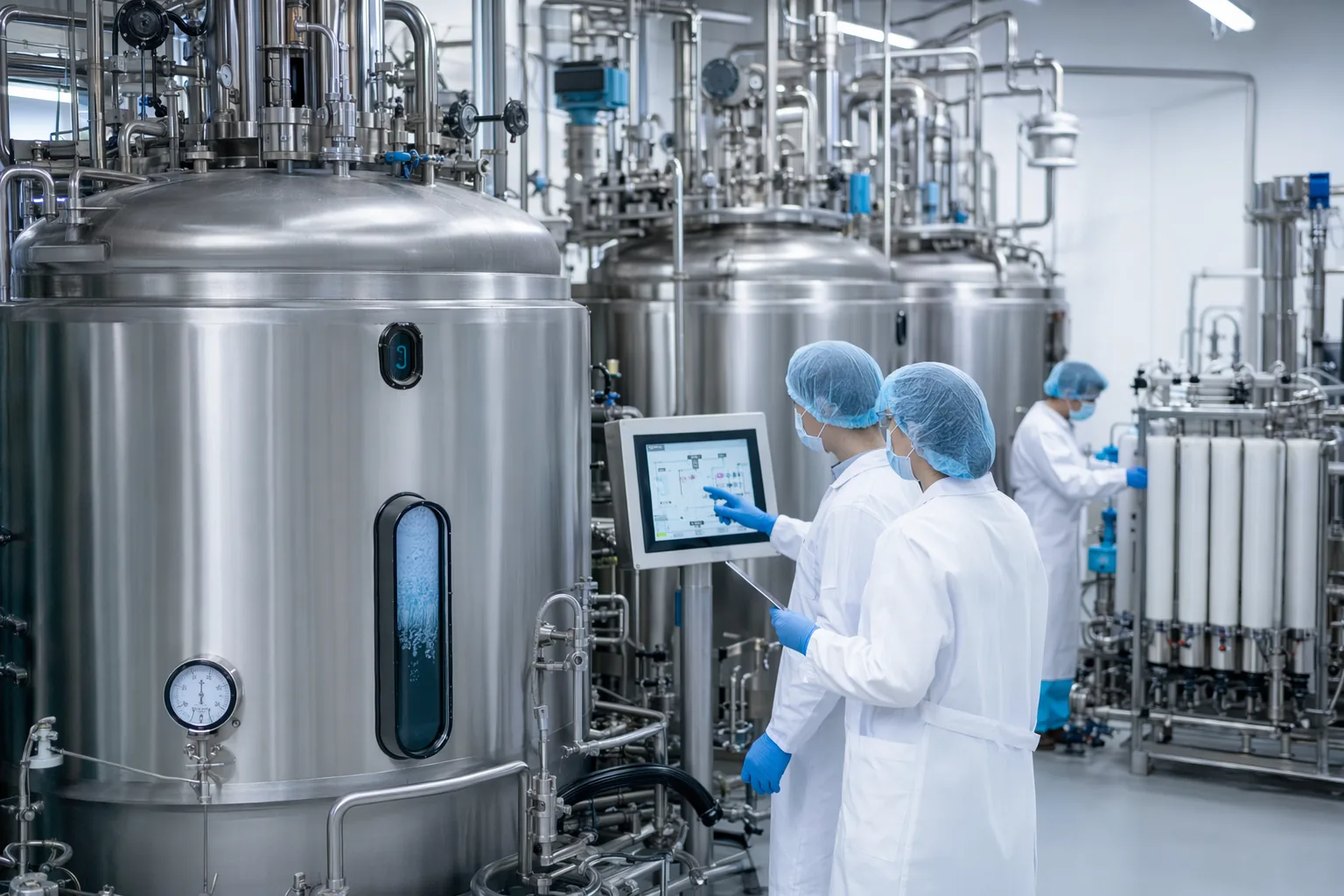
A practical guide to alkaline protease production, scale-up, quality control, and supplier evaluation for detergent, leather, and textile applications.
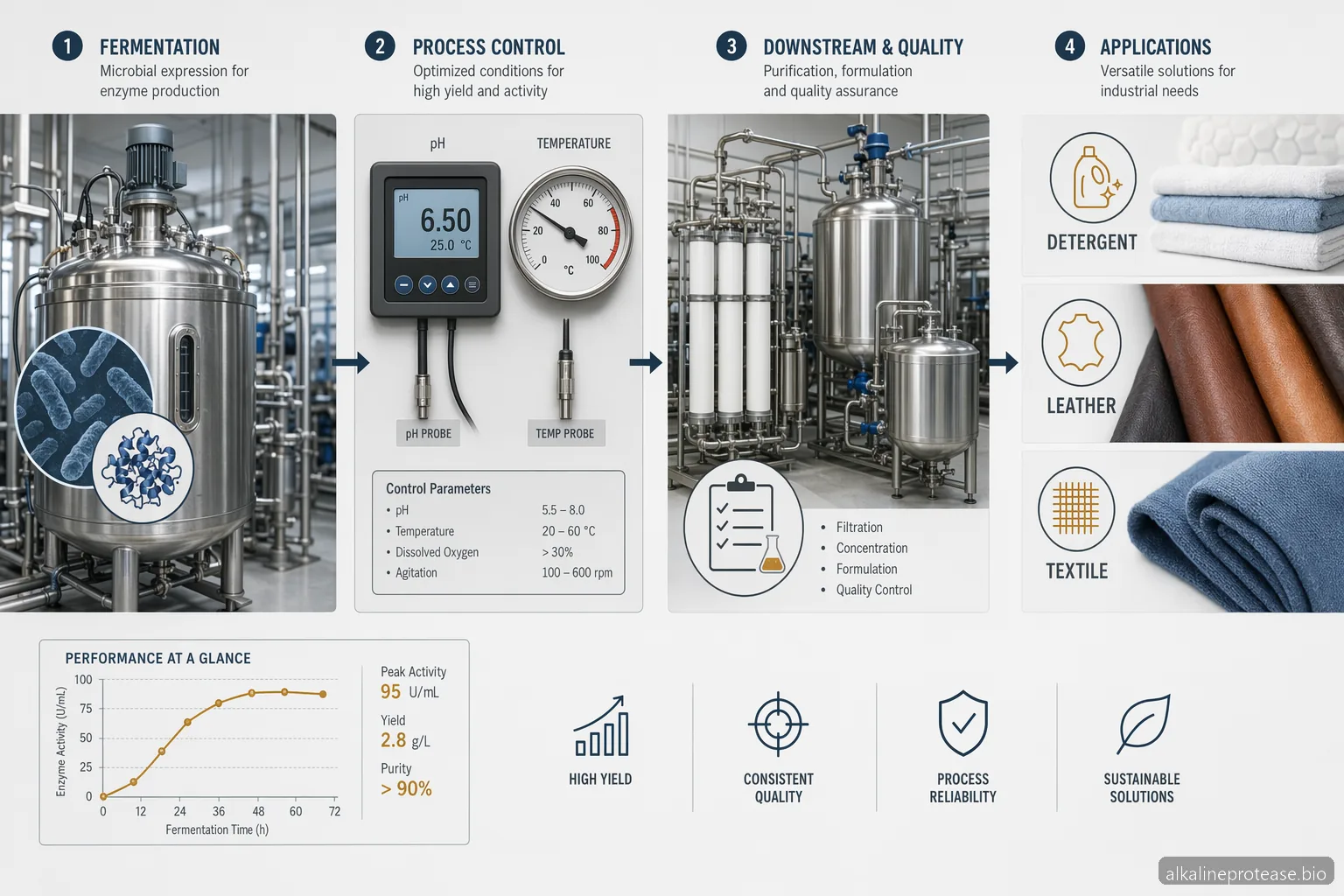
What Industrial Alkaline Protease Production Involves
Alkaline protease production is the controlled manufacture of proteolytic enzymes that remain active under alkaline conditions, commonly around pH 8.0–11.0. For B2B buyers, the objective is not maximum lab activity alone, but consistent performance in laundry detergent, leather processing, and silk degumming at a predictable cost-in-use. A typical industrial alkaline protease production process starts with strain selection and seed culture, then moves to submerged aerobic fermentation, broth clarification, enzyme concentration, stabilization, and final liquid or powder formulation. Subtilisin-type enzymes from Bacillus species are widely used because they can deliver strong protein stain removal and robust alkaline stability. The best production plan links fermentation targets with downstream requirements, such as low bioburden, controlled moisture, dust management, and compatibility with surfactants, builders, oxidants, and process auxiliaries.
Typical use pH: 8.0–11.0, depending on enzyme grade • Common fermentation mode: aerobic submerged fermentation • Final formats: stabilized liquid, granule, or powder • Key buyer metric: performance per kilogram of finished formulation
Strain Selection and Production Media
The production of alkaline protease from microorganisms depends on strain productivity, biosafety, secretion efficiency, and downstream purification burden. Industrial producers commonly evaluate Bacillus-derived subtilisin strains because extracellular secretion simplifies recovery and supports large-scale economics. Research reports may describe production of alkaline protease from Pseudomonas aeruginosa, but this organism can raise biosafety, toxin, and regulatory concerns; for industrial supply, buyers should ask how strain identity, containment, purification, and absence of undesirable metabolites are verified. Alkaline protease production media normally include carbon sources such as starch, glucose, molasses, or glycerol; nitrogen sources such as soybean meal, yeast extract, peptone, or corn steep liquor; and mineral salts for growth and enzyme expression. Media optimization should balance activity yield with raw material consistency, filtration behavior, foaming tendency, and final impurity profile.
Request strain lineage and production organism disclosure where commercially possible • Confirm media components relevant to allergens, animal origin, or customer restrictions • Assess lot-to-lot raw material variability during supplier qualification • Avoid selecting a supplier on fermentation titer alone
Fermentation Conditions and Process Control
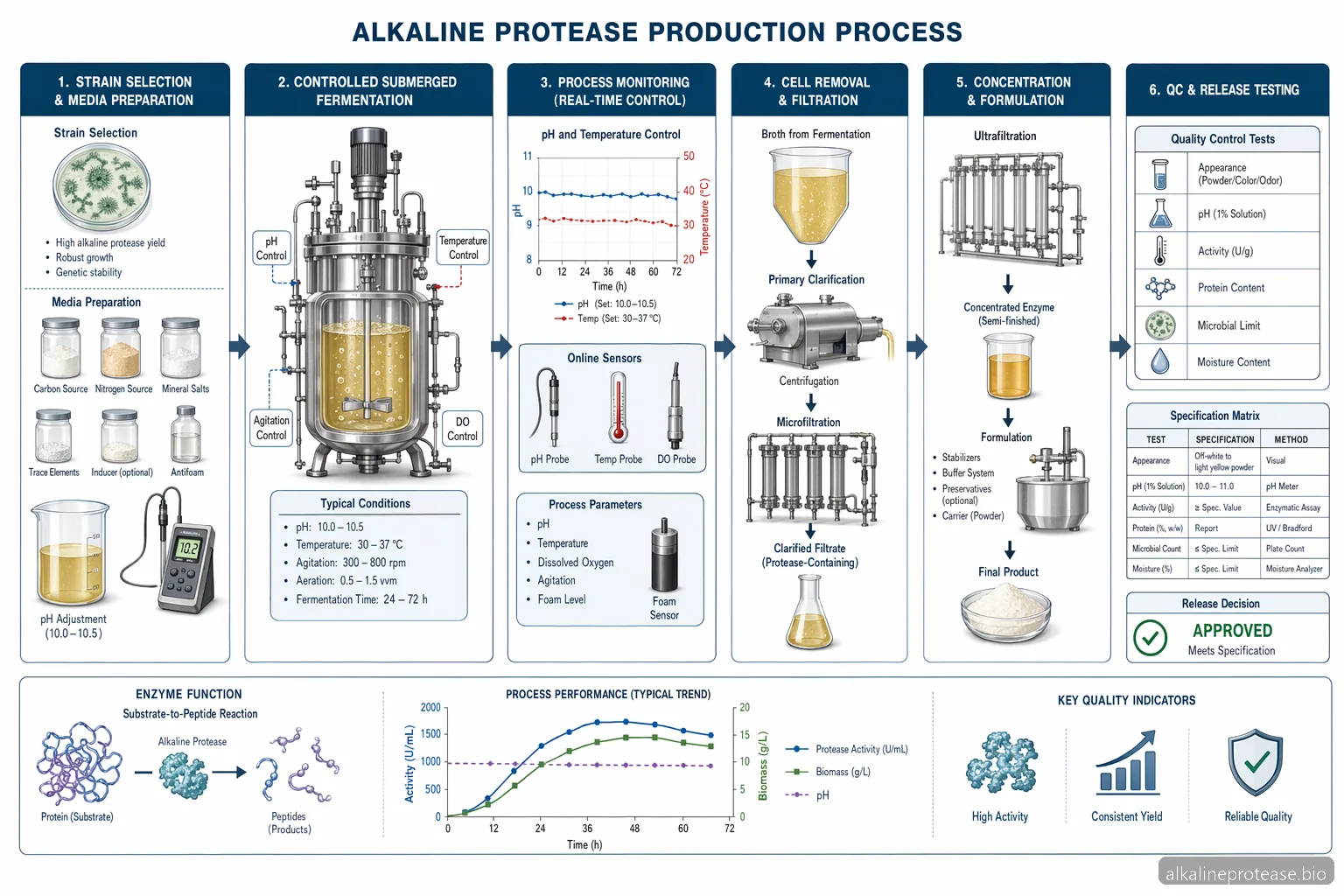
An industrial scale alkaline protease production flow usually includes master cell bank revival, seed train expansion, production fermentation, harvest, clarification, and downstream finishing. Fermentation is commonly run near 30–37°C for mesophilic producers, with pH controlled around 7.5–10.0 depending on strain and enzyme expression profile. Dissolved oxygen is typically maintained through agitation, sterile air, back pressure, and antifoam control. The redox potential for alkaline protease enzymes production is not a universal set point, but oxidation-reduction potential can be tracked alongside dissolved oxygen to detect oxygen limitation, metabolic shifts, contamination, or overfeeding. Feed strategy, especially carbon and nitrogen addition, should prevent catabolite repression and excessive viscosity. Buyers reviewing an industrial scale alkaline protease production diagram should ensure it identifies critical control points, sampling frequency, cleaning steps, and hold-time limits.
Typical fermentation temperature: 30–37°C for many commercial strains • Common pH control band: approximately 7.5–10.0 • Monitor pH, dissolved oxygen, foam, temperature, viscosity, and bioburden • Validate hold times between harvest, clarification, and stabilization
Downstream Processing, Formulation, and QC
After fermentation, the alkaline protease production process shifts from biological yield to product consistency. Broth is usually separated by centrifugation or filtration to remove biomass, then concentrated by ultrafiltration or evaporation under enzyme-safe conditions. Stabilizers may include polyols, salts, calcium sources, preservatives, or compatible carriers, depending on whether the product is liquid, granulated, or powder. For detergent grades, formulation should account for surfactant compatibility, oxidant tolerance, storage temperature, and granule dust control. For leather and silk applications, the focus may shift to controlled hydrolysis, fiber protection, and clean rinse behavior. QC checks should include enzyme activity by a defined assay, pH, moisture or solids, microbial limits, appearance, density or particle size, and stability. Buyers should require a current COA, TDS, and SDS for every commercial grade.
Confirm activity units and assay substrate before comparing suppliers • Check stability at intended warehouse and transport temperatures • Review preservative system for liquid grades • Require batch COA plus TDS and SDS during approval
Scale-Up, Pilot Validation, and Supplier Qualification
Industrial alkaline protease production should be qualified by application testing, not only by factory specifications. During pilot validation, buyers can compare dosage bands such as 0.05–0.5% enzyme preparation in detergent powders or liquids, or process-specific ppm activity levels in leather soaking, bating, or silk degumming trials. Exact dosage depends on enzyme activity, substrate load, contact time, temperature, pH, and formulation inhibitors. Cost-in-use analysis should include enzyme price, required dose, rework reduction, cycle time, wastewater impact, storage stability, and handling losses. Supplier qualification should cover manufacturing capacity, batch traceability, change control, contamination controls, sample retention, technical service, documentation response time, and continuity planning. A robust supplier will support lab screening, pilot batches, and scale-up troubleshooting before long-term commercial commitment.
Run side-by-side trials under your real operating pH and temperature • Calculate cost-in-use rather than price per kilogram only • Ask for change notification and batch traceability procedures • Confirm packaging, shelf life, and transport temperature guidance
Technical Buying Checklist
Buyer Questions
Most commercial alkaline protease production uses aerobic submerged fermentation because it supports controlled pH, temperature, aeration, nutrient feeding, and scale-up. The process usually includes seed culture, production fermentation, biomass removal, concentration, stabilization, and final formulation. Solid-state fermentation exists for some applications, but submerged systems are more common when buyers need consistent enzyme activity, documentation, and repeatable industrial supply.
Many microorganisms can produce alkaline protease, including Bacillus, Pseudomonas, Aspergillus, and other bacteria or fungi. Industrial detergent and processing enzymes often rely on Bacillus-derived subtilisin because extracellular secretion and alkaline performance are favorable. If a supplier references production of alkaline protease from Pseudomonas aeruginosa, buyers should carefully review biosafety controls, purification validation, impurity testing, and suitability for the intended market.
Start with equivalent activity units and application testing. Review the COA, TDS, SDS, assay method, shelf life, microbial specifications, storage guidance, and sample retention policy. Then compare cost-in-use at the required dose in your formulation or process. Supplier qualification should also include production capacity, traceability, change control, technical support, lead time reliability, and performance during pilot validation.
The most important controls are strain quality, media composition, pH, temperature, dissolved oxygen, foam, feed rate, and contamination prevention. Many commercial fermentations operate around 30–37°C and mildly alkaline to alkaline pH, but exact set points are strain-specific. Redox potential can provide useful supporting information, especially for detecting oxygen limitation or metabolic changes, but it should not replace dissolved oxygen and activity monitoring.
A practical screening range for detergent formulations may start around 0.05–0.5% of the enzyme preparation, adjusted for declared activity, wash temperature, soil load, surfactants, builders, and oxidants. Textile and leather trials should be based on activity per process mass, liquor ratio, pH, temperature, and contact time. Final dosage should be confirmed through pilot validation and cost-in-use analysis.
Alkaline Protease for Research & Industry
Need Alkaline Protease for your lab or production process?
ISO 9001 certified · Food-grade & research-grade · Ships to 80+ countries
Frequently Asked Questions
What is the main industrial method for alkaline protease production?
Most commercial alkaline protease production uses aerobic submerged fermentation because it supports controlled pH, temperature, aeration, nutrient feeding, and scale-up. The process usually includes seed culture, production fermentation, biomass removal, concentration, stabilization, and final formulation. Solid-state fermentation exists for some applications, but submerged systems are more common when buyers need consistent enzyme activity, documentation, and repeatable industrial supply.
Which microorganisms are used for alkaline protease production?
Many microorganisms can produce alkaline protease, including Bacillus, Pseudomonas, Aspergillus, and other bacteria or fungi. Industrial detergent and processing enzymes often rely on Bacillus-derived subtilisin because extracellular secretion and alkaline performance are favorable. If a supplier references production of alkaline protease from Pseudomonas aeruginosa, buyers should carefully review biosafety controls, purification validation, impurity testing, and suitability for the intended market.
How should buyers compare alkaline protease enzyme suppliers?
Start with equivalent activity units and application testing. Review the COA, TDS, SDS, assay method, shelf life, microbial specifications, storage guidance, and sample retention policy. Then compare cost-in-use at the required dose in your formulation or process. Supplier qualification should also include production capacity, traceability, change control, technical support, lead time reliability, and performance during pilot validation.
What conditions matter most in alkaline protease fermentation?
The most important controls are strain quality, media composition, pH, temperature, dissolved oxygen, foam, feed rate, and contamination prevention. Many commercial fermentations operate around 30–37°C and mildly alkaline to alkaline pH, but exact set points are strain-specific. Redox potential can provide useful supporting information, especially for detecting oxygen limitation or metabolic changes, but it should not replace dissolved oxygen and activity monitoring.
What dosage should be used in detergent or textile trials?
A practical screening range for detergent formulations may start around 0.05–0.5% of the enzyme preparation, adjusted for declared activity, wash temperature, soil load, surfactants, builders, and oxidants. Textile and leather trials should be based on activity per process mass, liquor ratio, pH, temperature, and contact time. Final dosage should be confirmed through pilot validation and cost-in-use analysis.
Related: Alkaline Protease for Detergent and Laundry Formulation
Turn This Guide Into a Supplier Brief Request a technical review, sample, COA, TDS, and SDS for your alkaline protease production or application trial. See our application page for Alkaline Protease for Detergent and Laundry Formulation at /applications/alkaline-protease-detergent-laundry/ for specs, MOQ, and a free 50 g sample.
Contact Us to Contributehello@mail.alkalineprotease.bio