Alkaline Protease Solutions for Industry
Optimised alkaline protease delivers consistent protein hydrolysis performance under demanding alkaline production conditions, reducing chemical load and enhancing throughput.
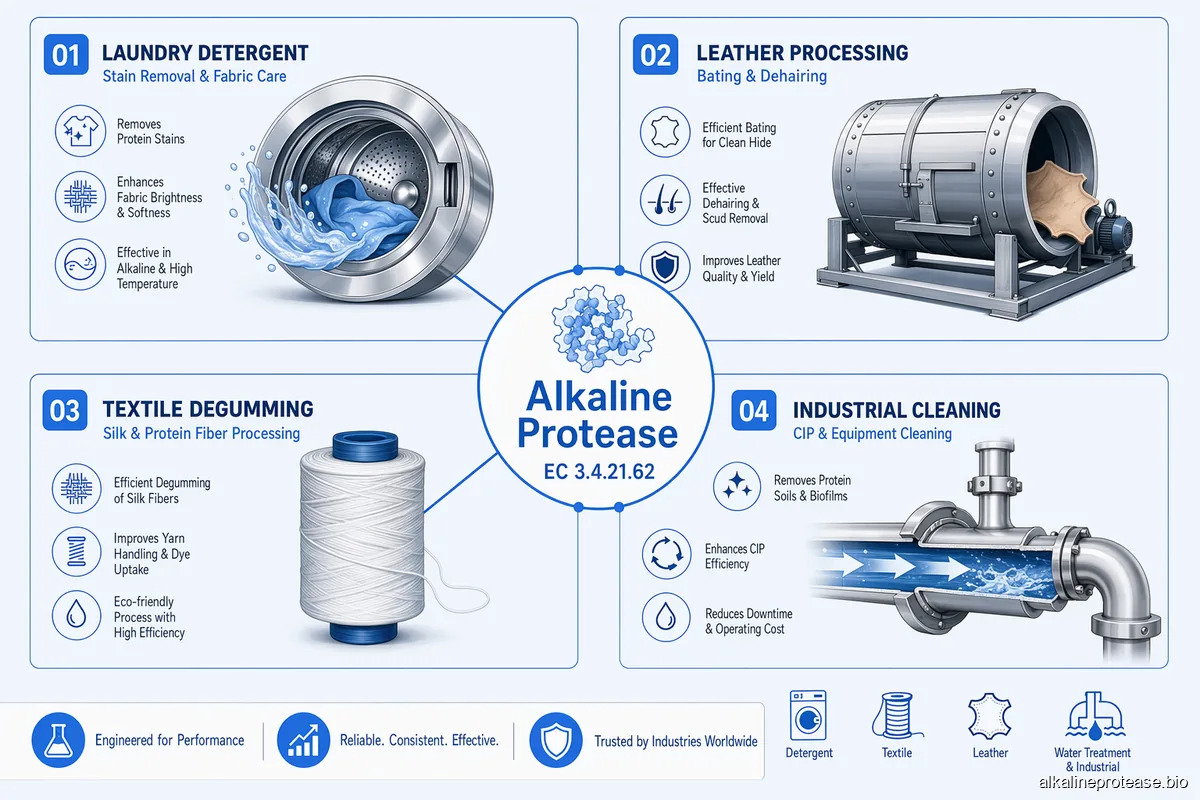
Protein residues are a persistent challenge in many industrial sectors, from textile and leather manufacturing to food production and CIP equipment cleaning. Conventional chemical methods for removing these residues often require high reagent volumes, pose effluent disposal problems, and risk product quality degradation. As markets shift toward efficiency, sustainability, and compliance, procurement teams seek high-assay, targeted inputs that maintain productivity across diverse operations. Alkaline protease, a serine protease (EC 3.4.21.62) from Bacillus licheniformis, provides a proven pathway for cost-effective protein hydrolysis in alkaline environments. Its catalytic action breaks complex proteins into smaller peptides and amino acids, enabling cleaner surfaces, improved material handling, and enhanced ingredient performance. Operating optimally at pH 8.0–11.0 and 40°C–60°C, it aligns with typical industrial wash or process cycles and integrates readily into formulations for detergent, leather, protein recovery, and cleaning systems. Supplied as a white to light tan powder at 100,000–200,000 U/g activity, this grade is packaged in 25 kg fiber drums with custom options available, meeting ISO 9001, HALAL, KOSHER, and Food Grade standards. The versatility supports existing formulations and new product development, delivering reduced waste streams, lower energy inputs, and minimal process disruption.
Laundry Detergent Formulation
In alkaline detergent systems, protein stains are among the hardest soils to remove at scale. Alkaline protease hydrolyzes blood, egg, grass, and food residues during the wash, improving stain release without increasing caustic usage. Performance is strongest in the 40°C–60°C range at alkaline pH, enabling high-performing enzyme-boosted cleaning products.
Leather Dehairing and Bating
Leather processors use alkaline protease to reduce reliance on sodium sulfide and other aggressive chemicals. At pH 8–11, it supports controlled hair loosening and uniform bating, improving hide quality and reducing wastewater impact. The commercial value lies in lower chemical usage, better process control, and cleaner downstream effluent.
Protein Recovery from Byproducts
Fish offal, poultry byproducts, and similar protein-rich streams can be transformed into soluble fractions for feed and aquaculture ingredients. Alkaline protease improves hydrolysis efficiency under industrial conditions, supporting higher yields and predictable batch behavior, especially where markets reward sustainable production from low-value streams.
CIP and Industrial Cleaning
Dairy, brewing, and food plants face protein film buildup on tanks, pipes, and equipment. Alkaline protease formulated into CIP systems breaks down residues that detergents alone may not fully remove, reducing rework, extending cleaning efficiency, and supporting more stable hygienic production between runs.
| Parameter | Value |
| Enzyme | Alkaline Protease (EC 3.4.21.62) |
| Source organism | Bacillus licheniformis |
| Activity range | 100,000 – 200,000 U/g |
| Optimal pH | 8.0 – 11.0 |
| Optimal temperature | 40°C – 60°C |
Frequently Asked Questions
What is alkaline protease used for in industry?
Alkaline protease is a serine protease enzyme used to break down protein-based materials in alkaline production systems. Sourced from Bacillus licheniformis, it is applied in detergents, leather processing, protein recovery, and CIP cleaning where residues are difficult to remove by surfactants or caustic alone. Its main function is controlled protein hydrolysis within pH 8.0–11.0, improving process efficiency and yield.
How does alkaline protease improve cleaning efficacy?
By catalyzing the breakdown of protein soils into smaller soluble fragments, alkaline protease reduces residue adherence and enhances removal in alkaline wash or CIP systems. This targeted action helps minimise chemical loading, shortens cleaning cycles, and maintains performance across temperatures and pH values in its optimal activity range.
What dosage range should buyers expect for production trials?
Dosage depends on the substrate, target soil load, and formulation. Industrial teams typically begin with lab screening and pilot batches to optimise dosage. In detergent, CIP, or hydrolysis applications, loading is fine-tuned using activity values, process pH, temperature, and contact time. Suppliers should support application testing so dosage can be determined by performance targets rather than activity alone.
What should procurement evaluate when comparing suppliers?
Procurement teams should compare activity, stability, packaging, documentation, and lot consistency. Key checks include pH and temperature profile, shelf life, certifications, MOQ, and supply format. For food, cleaning, or leather uses, technical data and traceability matter. Suppliers offering custom packaging and reliable delivery are typically easier to qualify for production.
Can alkaline protease be used outside detergent markets?
Yes. Applications extend beyond laundry to leather dehairing, protein recovery from byproducts, industrial cleaning, and ingredient manufacturing. Its function in attacking protein structures under alkaline conditions improves process efficiency and reduces reliance on harsher chemistry, making it a versatile industrial input.
Request Bulk Alkaline Protease Supply
For manufacturers, distributors and resellers. Tell us the product or grade, the quantity, your application and the destination country. We'll recommend an activity grade, send a free 100 g sample with COA/TDS, and quote bulk supply within 24 hours.
Get Quote