Alkaline Protease for Silk Degumming and Sericin Removal
Remove sericin protein from raw silk fiber with alkaline protease at pH 8.0–10.0 and 40–55°C to improve luster, handle, and dye uniformity.
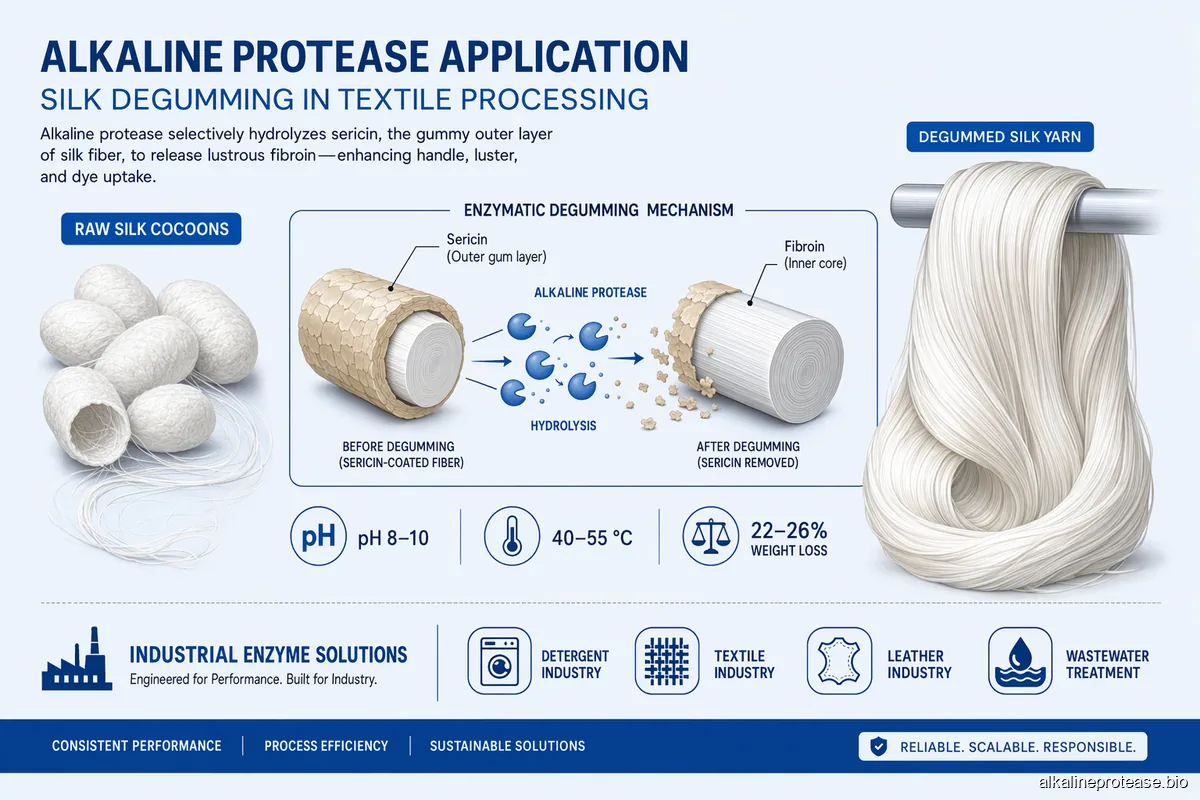
Raw silk fiber from Bombyx mori silkworm cocoons consists of two structural components: fibroin, the core protein responsible for silk's characteristic luster and tensile strength, and sericin, the outer gum protein that binds fibroin filaments together in the cocoon. Sericin makes raw silk stiff, dull, and difficult to dye uniformly. The silk degumming process removes sericin to expose the fibroin core, revealing the characteristic softness, lustre, and dye receptivity that gives silk its premium value. Traditional degumming uses prolonged scouring with sodium carbonate at high temperatures (90–100°C), which removes sericin but can damage fibroin, reducing tensile strength and lustre. Alkaline protease provides a gentler, enzyme-assisted degumming method that selectively hydrolyses sericin — a random coil protein — while leaving the crystalline fibroin structure largely intact. At pH 8.0–10.0 and 40–55°C, alkaline protease at 0.5–2.0% o.w.f. (on weight of fabric) removes sericin within 30–90 minutes, producing degummed silk with higher tensile strength retention, improved luster, and better dye exhaustion compared to high-temperature alkaline scouring. The mechanism is selective: sericin is hydrophilic and amorphous, making it accessible to protease in aqueous solution, while fibroin has a tightly packed beta-sheet crystalline core that resists protease attack under mild conditions. This selectivity is the central value of enzymatic degumming over chemical methods. For silk processors and dye houses evaluating alkaline protease silk degumming, key process parameters include protease activity (U/g), sericin removal efficiency (weight loss of 20–25% on scoured weight), fibroin tensile strength retention, and compatibility with the subsequent dyeing process. Our alkaline protease from Bacillus licheniformis is active across the degumming pH range, supplied at 100,000–200,000 U/g with full documentation, and has been validated in silk processing trials at standard degumming conditions.
Filament Silk Yarn Degumming
Continuous filament silk yarn wound on reels or bobbins is degummed by immersion in alkaline protease bath at pH 8.5–9.5, 45–55°C for 45–90 minutes at 1.0–2.0% o.w.f. enzyme dosage. Weight loss of 22–26% confirms adequate sericin removal. Compared to alkaline scouring at 95°C, protease degumming achieves equivalent weight loss at 45°C with higher tensile strength retention (typically +8–15% breaking strength).
Woven Silk Fabric Degumming
Woven silk fabrics present a higher surface area-to-volume ratio than yarn, allowing effective degumming at shorter contact times. Alkaline protease at 0.5–1.5% o.w.f., pH 8.0–9.0, 40–50°C for 30–60 minutes is typical. Fabric handle and lustre after enzymatic degumming is superior to alkali treatment, and dye uptake is more uniform due to complete sericin removal without fibroin surface damage.
Spun Silk and Noil Processing
Spun silk and silk noil — short-fibre byproducts from reeling — carry higher sericin loads and more variable protein composition than filament silk. Alkaline protease at 1.5–2.5% o.w.f. at pH 9.0–10.0 and 50–55°C for 60–120 minutes addresses this more resistant substrate. Pre-treatment with mild alkali at pH 9–10 for 15 minutes can enhance enzyme accessibility before the protease step.
Combined Degumming and Whitening Process
Alkaline protease degumming can be combined with hydrogen peroxide whitening in a two-step sequence (degum first, then peroxide bleach) or in optimised bath sequences where pH is adjusted between steps. The protease step at pH 8.5–9.5 is completed first, followed by pH adjustment to 10–11 for peroxide bleaching, avoiding enzyme denaturation from oxidative exposure while achieving the whiteness required for top-grade piece-dyed silk.
| Parameter | Value |
| Activity range | 100,000 – 200,000 U/g |
| Optimal pH | 8.0 – 10.0 |
| Optimal temperature | 40°C – 55°C |
| Form | White to light tan powder |
| Shelf life | 12 months (sealed, cool, dry place) |
| Packaging | 25 kg drums / custom packaging |
Frequently Asked Questions
Why is alkaline protease preferred over chemical scouring for silk degumming?
High-temperature alkaline scouring (90–100°C, Na2CO3) removes sericin but causes fibroin surface damage, reducing tensile strength and lustre. Alkaline protease degumming works at 40–55°C and selectively hydrolyses sericin — which is amorphous and accessible — while leaving the crystalline fibroin core intact. The result is higher tensile strength retention (typically 8–15% stronger yarn), superior lustre, and more uniform dye uptake, all at lower energy cost.
How do you measure complete sericin removal in silk degumming?
The primary measurement is weight loss: fully degummed silk loses 22–26% of its original weight, corresponding to complete sericin removal. Additional verification methods include Millon's reagent testing (sericin is positive, fibroin negative), scanning electron microscopy to confirm fibroin surface cleanliness, and dye exhaustion testing showing uniform dye uptake across the fabric — poor degumming shows as dye patchiness.
What dosage of alkaline protease is used in silk degumming?
Typical dosage is 0.5–2.0% on weight of fabric (o.w.f.) at pH 8.0–10.0 and 40–55°C for 30–90 minutes, depending on silk form (yarn, fabric, noil) and sericin content. Filament yarn requires moderate dosing with longer contact time; woven fabric responds to lower dosage at shorter times. Spun silk and noil require higher dosing due to more complex sericin composition. A trial at multiple dosage levels is recommended for new silk sources.
Is the alkaline protease compatible with subsequent dyeing processes?
Yes. Enzymatic degumming at pH 8.0–9.5 does not introduce reactive groups or contaminants that interfere with acid, reactive, or direct dye systems used for silk. The protease is inactivated by a hot rinse (70°C, 10 minutes) or by transition to the dye bath pH, which is typically more acidic. Enzymatically degummed silk shows better dye exhaustion and levelness compared to chemically scoured material.
Request Alkaline Protease for Silk Degumming
Specify your application and process parameters. We'll recommend an activity grade, send a free 100 g sample with COA/TDS, and quote bulk pricing within 24 hours.
Get Quote