Alkaline Protease for Detergent and Laundry Formulation
Remove protein-based stains from fabric at pH 9–11 with alkaline protease enzyme — the standard active in commercial laundry detergent powder and liquid formulations.
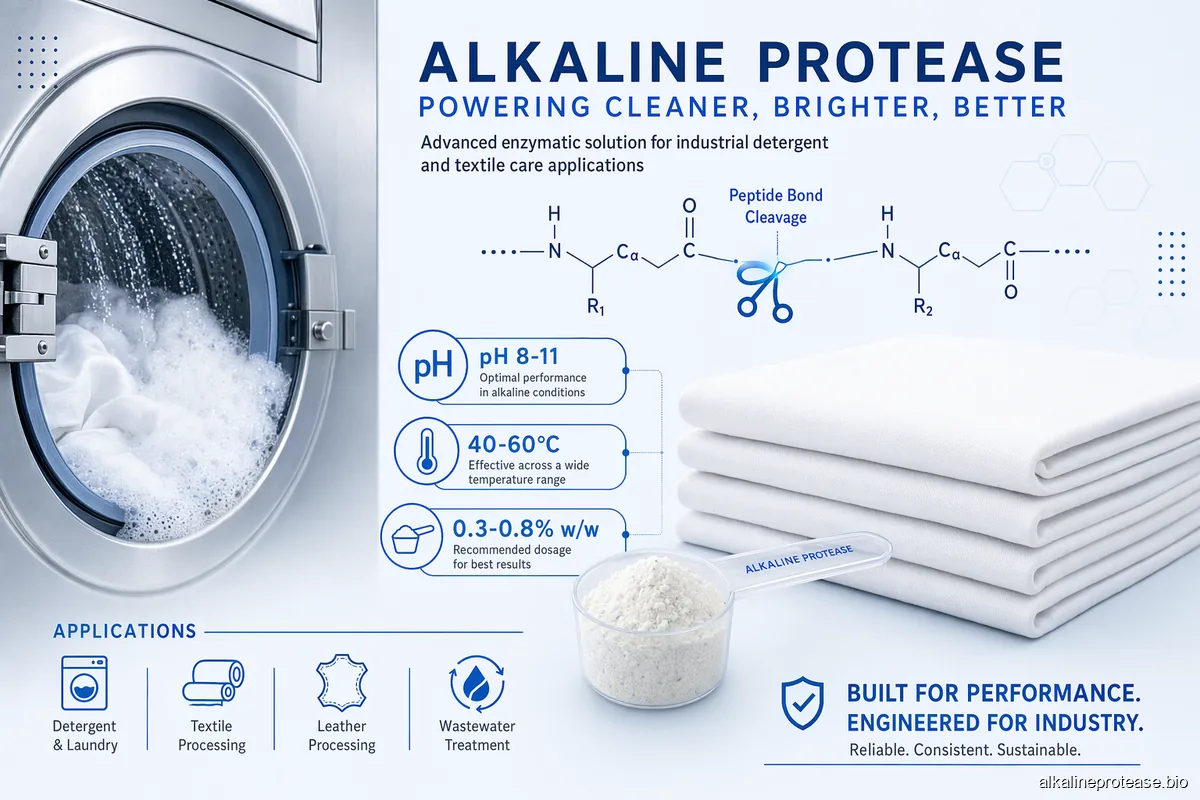
Protein-based stains — blood, egg, grass, sweat, milk, and food soils — are among the most persistent laundry challenges because their cross-linked protein structures adhere strongly to textile fibres and resist removal by surfactants alone at low wash temperatures. Alkaline protease (EC 3.4.21.62), a subtilisin-type serine endopeptidase produced from Bacillus licheniformis, is the enzyme of choice for protein stain removal in commercial laundry detergent formulations. It hydrolyses the peptide bonds in protein soils, breaking them into soluble peptides and amino acids that are rinsed away in the wash liquor. Active at pH 8.0–11.0 and 40–60°C, alkaline protease performs effectively across both powder and liquid detergent systems and is compatible with the anionic and nonionic surfactant systems most commonly used in commercial laundry products. In powder detergents, alkaline protease is typically supplied as a granulate or encapsulated form to protect against moisture and ensure shelf-stable activity. In liquid detergents, it is formulated with stabilisers such as propylene glycol, borate, or calcium salts to maintain activity over a 12-month shelf life. Typical dosing is 0.3–0.8% w/w active enzyme in powder detergents and 0.3–1.2% w/w in liquid formulations, adjusted to washing temperature, soil load, and market tier. For high-performance cold-wash detergents (20–30°C), higher activity grades (up to 600,000 U/g) or cold-active variants may be specified. The commercial case for including alkaline protease in detergent formulations is clear: it improves protein stain removal performance, allows formulators to reduce caustic or bleach content, and enables effective cleaning at lower temperatures — supporting energy label claims and sustainability positioning. For detergent formulation chemists and procurement teams, key supplier parameters include confirmed activity (U/g, casein or Suc-AAPF-pNA basis), surfactant compatibility data, oxidative stability (important for detergents with peroxide bleach), temperature stability profile, and available forms (powder, liquid, granulate). Our alkaline protease is produced from Bacillus licheniformis at 100,000–600,000 U/g, supplied with full COA, TDS, and MSDS, and offered as free-flowing powder with custom granulation available.
Powder Laundry Detergent Formulation
In powder detergent systems, alkaline protease at 0.3–0.8% active enzyme removes blood, egg, sweat, and food protein stains during a standard 40–60°C wash cycle at pH 9–11. Protease granulates with protective coatings are preferred for powder systems to ensure storage stability and prevent premature activation in the compact format. Activity of 100,000–200,000 U/g is standard for mainstream formulations.
Liquid Laundry Detergent Stabilisation
Liquid detergent formulations present an enzyme stability challenge because the enzyme is in aqueous contact with surfactants and pH-adjusting agents throughout shelf life. Alkaline protease for liquid detergent must be compatible with the surfactant system and stabilised with borate/polyol or calcium chloride stabiliser packages. Testing at 37°C for 8 weeks under accelerated storage conditions confirms adequate shelf life before launch.
Cold-Wash and Energy-Efficient Formulations
Growing consumer and regulatory pressure toward 20–30°C wash cycles requires alkaline protease grades with demonstrated activity at lower temperatures. High-activity variants at 400,000–600,000 U/g or engineered cold-active subtilisins maintain effective protein stain removal below 30°C, supporting energy-label claims and low-temperature performance advertising for premium laundry brands.
Institutional and Industrial Laundry
Institutional laundry operations for hotels, hospitals, and food service facilities handle high protein soil loads — blood-stained linens, food-contaminated workwear — typically at 60°C. Alkaline protease at 0.5–1.0% in liquid or powder format reduces the need for hot wash cycles and pre-soaking, cutting water heating energy and chemical usage while maintaining hygiene standards required for institutional textile processing.
| Parameter | Value |
| Activity range | 100,000 – 600,000 U/g |
| Optimal pH | 8.0 – 11.0 |
| Optimal temperature | 40°C – 60°C |
| Form | White to light tan powder / granulate |
| Shelf life | 12 months (sealed, cool, dry place) |
| Packaging | 25 kg drums / 25 kg jerricans |
Frequently Asked Questions
What protein stains does alkaline protease remove in laundry?
Alkaline protease hydrolyses all protein-based stains: blood, egg, grass, sweat, milk, meat juice, and food soils. It cleaves peptide bonds in the protein matrix, breaking large insoluble stain molecules into soluble peptides and amino acids that are rinsed away in the wash. It is particularly effective on blood and egg stains where other surfactants show limited performance at standard wash temperatures.
What is the standard alkaline protease dosage in powder detergents?
Typical active enzyme dosage in powder detergents is 0.3–0.8% w/w, equivalent to 0.15–0.4% of a 200,000 U/g grade. Liquid detergents typically require 0.3–1.2% active enzyme due to the more diluted wash liquor conditions. Final dosage is set during formulation development based on wash temperature, soil load, product tier, and cost-in-use targets, and should be confirmed by in-house stain removal testing.
Is alkaline protease compatible with peroxide-based bleach systems?
Standard alkaline proteases show limited oxidative stability and lose activity in contact with peroxide bleach during the wash. For detergents containing sodium percarbonate or perborate, oxidatively stable protease variants are required. These engineered subtilisins maintain activity in the presence of up to 100 ppm H2O2. Always confirm oxidative stability compatibility with the supplier when formulating for bleach-containing systems.
How is alkaline protease supplied for detergent manufacturing?
For powder detergents, alkaline protease is typically supplied as a coated granulate with a protective layer that dissolves rapidly in the wash but protects the enzyme during storage and mixing. Liquid detergent applications use liquid enzyme concentrate with stabiliser packages included. We supply powder grades at 100,000–600,000 U/g with COA, TDS, and surfactant compatibility data. Custom granulation formats are available for established accounts.
Request Alkaline Protease for Detergent Formulation
Specify your application and process parameters. We'll recommend an activity grade, send a free 100 g sample with COA/TDS, and quote bulk pricing within 24 hours.
Get Quote