Alkaline Protease for Wastewater Biofilm Treatment
Break down protein-based biofilms and improve activated sludge efficiency in industrial wastewater treatment using alkaline protease at pH 8.0–10.0.
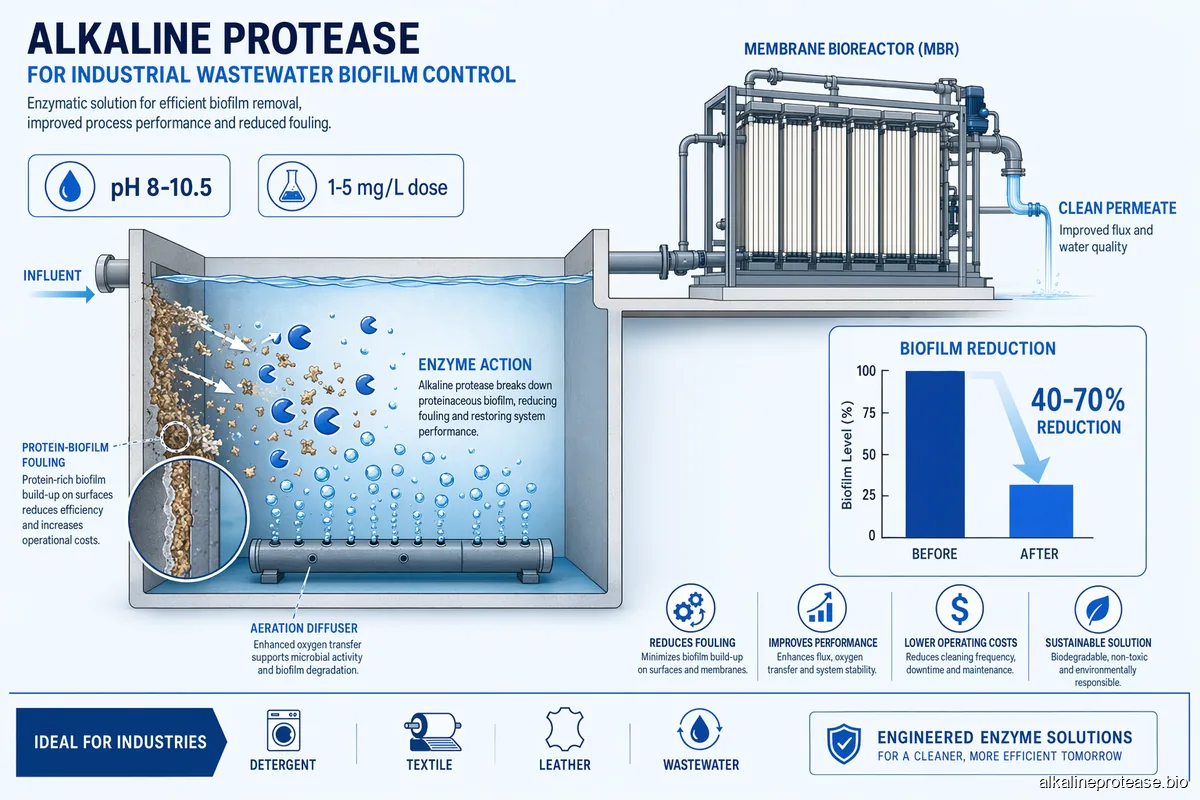
Industrial wastewater from food processing, dairy operations, breweries, tanneries, and pharmaceutical manufacturing contains high concentrations of protein and peptide materials that accumulate as biofilm on pipes, tanks, aeration equipment, and membrane surfaces in biological treatment systems. These protein-rich biofilms create multiple operational problems: they reduce oxygen transfer efficiency in aeration systems, increase hydraulic resistance in pipes and channels, accelerate fouling of ultrafiltration and microfiltration membranes used in membrane bioreactors (MBR), and can harbour pathogenic bacteria that complicate effluent quality compliance. Alkaline protease (EC 3.4.21.62) applied in wastewater treatment specifically targets the protein matrix of biofilms — a key structural component along with extracellular polysaccharides (EPS). By hydrolysing the protein scaffold, alkaline protease disrupts biofilm integrity, reducing adhesion and facilitating removal by fluid shear or chemical cleaning. In activated sludge systems, protease activity can also improve sludge hydrolysis, releasing nutrients trapped in bacterial cell protein for more efficient biological treatment, reducing total sludge volume. Typical application in wastewater treatment is via dosing into the biofilm-affected section of the treatment system at pH 8.0–10.5 and ambient temperature (20–40°C depending on climate and season). Effective concentration in the treatment liquid is typically 1–10 mg/L active enzyme protein, depending on biofilm load and contact time. For membrane bioreactor systems, alkaline protease can be incorporated into the CIP (clean-in-place) protocol for membrane modules, complementing sodium hypochlorite cleaning by pre-digesting the protein component of the fouling layer before the oxidative clean, reducing chemical consumption and extending membrane life. Environmental safety of enzyme-based biofilm treatment is well-established: proteases are biodegradable, produce no persistent by-products, and are accepted in effluent streams subject to activated sludge treatment. For wastewater treatment operators and equipment suppliers, alkaline protease offers a targeted, biodegradable complement to chemical biofilm control.
Protein Biofilm Removal in Food Processing Wastewater
Dairy, poultry, and meat processing facilities generate wastewater with 500–3,000 mg/L protein load. Biofilm accumulates on aeration diffusers, weirs, and pipe internals. Alkaline protease dosing at 2–5 mg/L into the aeration basin or collection channels at pH 8.0–9.5 disrupts the protein matrix, reducing biofilm thickness by 40–70% in 48–72 hours based on field trials in food industry wastewater systems.
Membrane Bioreactor (MBR) Fouling Control
Protein-based fouling (biofouling + scaling) is the primary cause of flux decline in MBR systems treating food processing effluent. Alkaline protease CIP at 0.5–2.0 g/L in alkaline wash solution (pH 9.0–10.0, 35–45°C, 30–60 minutes) dissolves the protein fouling layer before the hypochlorite oxidative clean step. Studies show 25–40% improvement in membrane flux recovery compared to hypochlorite-only CIP.
Activated Sludge Enhancement and Sludge Reduction
Alkaline protease supplementation in activated sludge systems hydrolyses extracellular protein in sludge flocs, releasing nutrients for bacterial metabolism and improving sludge dewaterability. Dosing at 1–3 mg/L into the aeration basin at pH 7.5–9.0 can reduce total sludge volume by 5–12% over 30-day trials, lowering sludge disposal costs and improving effluent clarity.
Tannery Wastewater Protein Breakdown
Tannery effluent contains exceptionally high protein loads from dehairing, bating, and post-tanning operations. Alkaline protease applied in the equalisation basin at pH 8.5–10.0 and 30–40°C hydrolyses suspended and dissolved proteins, reducing BOD and COD loading on the biological treatment stage. This can reduce the organic loading rate on the activated sludge system and improve overall effluent quality.
| Parameter | Value |
| Activity range | 100,000 – 200,000 U/g |
| Optimal pH | 8.0 – 10.5 |
| Optimal temperature | 30°C – 55°C |
| Form | White to light tan powder |
| Shelf life | 12 months (sealed, cool, dry place) |
| Packaging | 25 kg drums / 25 kg jerricans |
Frequently Asked Questions
How does alkaline protease break down protein biofilm in wastewater systems?
Biofilm on pipe and equipment surfaces in wastewater systems contains a protein scaffold embedded in an extracellular polymeric substance (EPS) matrix. Alkaline protease hydrolyses the protein component by cleaving peptide bonds, disrupting the structural integrity of the biofilm and reducing its adhesion strength. Combined with fluid shear from pumping or aeration, this breaks up the biofilm layer and disperses it into the bulk liquid for removal in the biological treatment stage.
Is alkaline protease safe for use in wastewater and environmental discharge?
Yes. Alkaline proteases are biodegradable proteins that are rapidly degraded by microorganisms in activated sludge systems. They do not bioaccumulate, produce no persistent toxic by-products, and are accepted for use in effluent streams treated by biological processes. The enzyme itself is inactivated within 24–48 hours in active biological systems, and the amino acid hydrolysis products (peptides, amino acids) are readily metabolised by wastewater microorganisms.
What application method is recommended for wastewater biofilm treatment?
For continuous biofilm control, dosing alkaline protease at 1–5 mg/L active enzyme into the affected section of the wastewater system provides ongoing biofilm suppression. For periodic cleaning of membrane modules or pipe sections, a high-concentration CIP soak at 0.5–2.0 g/L in alkaline solution (pH 9.0–10.0, 35–45°C) for 30–60 minutes is effective. The optimal method depends on system design, biofilm load, and cleaning interval.
What documentation is available for wastewater and industrial cleaning applications?
We supply COA with protease activity, TDS, MSDS, and ISO 9001 certification. For wastewater applications, we can provide biodegradability data, pH stability profiles relevant to treatment system conditions, and application guidance for dosing calculations. Custom documentation packages for industrial water treatment compliance review are available upon request.
Request Alkaline Protease for Wastewater Treatment
Specify your application and process parameters. We'll recommend an activity grade, send a free 100 g sample with COA/TDS, and quote bulk pricing within 24 hours.
Get Quote